Decadal planning exercises are typically funded by federal agencies to give the broader community an opportunity to consensually identify potentially fertile research opportunities. At their best, they can jolt scientific disciplines out of a “normal science” rut and free up resources to explore new intellectual terrain. At their worst, they can endorse outright error that is propagated to the next generation.
As a veteran of co-writing half a dozen or so such national reports, I’ve been impressed by the outsized role these reviews can have on intellectual climate and capabilities. Take for example the positive effect that the National Research Council (NRC) project Physics and Chemistry of Earth Materials (PACEM) had on US geochemistry and mineral physics. In the mid-1980s, our nation had no large volume high-pressure-temperature apparatus or large geometry ion microprobe (conceived and built in Japan and Australia, respectively) nor dedicated synchrotron radiation or accelerator mass spectrometry facilities within the Earth sciences. The PACEM report (Prewitt et al., 1987) identified these major infrastructure needs and recommended immediate investments in each of these capabilities. Within a dozen years, the US was seen as a global leader across these research areas.
Discussing an example at the other extreme, writers on this blog have previously criticized the NASA-impaneled Community Workshop that explored “Biosignatures Standards of Evidence” (https://arxiv.org/abs/2210.14293) to evaluate claims of life detection for its favoring “instruction” over “rebellion” (Cleland, November 22, 2021; Harrison and Benner, May 25, 2022). Harrison and Benner specifically criticized texts within the White Paper they described as “morality tales”. Here, a Heroic Scientist is shown – mistakenly as it happens – to unmask the folly of a Fall Guy Scientist. Declared as a community “consensus”, the mistake becomes “truth” with no clear mechanism to correct the record.
Which brings us to the most recent planetary science and astrobiology decadal report (NASEM, 2023). Consider section Q9.4c:
What Is the Spectrum of Abiotic Processes for Which Abiosignatures Exist and What Subset of Those Abiosignatures Can Mimic Biosignatures on Earth?
The literature related to claims regarding the discovery of the earliest signs of life on Earth is replete with examples of false positive detections. For example, initial claims regarding the biological origin of isotopically light graphite in ~3.8 Ga rocks of the Akilia and Isua terranes of Greenland (Schidlowski et al. 1979; Mojzsis et al. 1996), were based in part on a lack of recognition that metamorphic decomposition of iron carbonate to form graphite and magnetite imparted an isotopic fractionation between graphite and carbonate that mimics that of photosynthetic metabolisms. Initial claims regarding the biogenicity of these graphite occurrences have largely been overturned in favor of an abiotic origin (van Zuilen et al. 2003).”
One can’t help but be struck by the authoritative conclusiveness of this passage, which addresses the use of measurements of the ratio of two isotopes of carbon (12C and 13C) as evidence that the carbon arose from a biological source. In Earth life, 13C is typically depleted by about 3% relative to abiological carbon in the reservoir. For ancient carbon preserved by geological accident to allow today’s scientists to measure its 12C to 13C ratio (reported in parts per thousand relative to inorganic carbon as δ13C), the interpretive question asks whether biology is the only way that a low measured ratio from ancient carbon could be presented in the modern lab. Two other possibilities are:
(1) The ancient carbon got its low δ13C ratio by a non-biological process that mimics biological processes in this feature, or
(2) The ancient carbon was replaced by more modern carbon, so the measurement reflects modern life, not ancient life.
To readers coming from outside of the field, the National Academies appear to have settled, once and for all, the legitimacy of pro-biology interpretations of ca. 3.8 Ga carbon made in two papers (Schidlowski et al. 1979; Mojzsis et al. 1996) who represent our Fall Guys. The Fall Guys made “false positive detections” about what may be “the earliest signs of life on Earth” because they lacked the “recognition” that a particular non-biological process (“metamorphic decomposition of iron carbonate”) could have instead produced the low δ13C ratio without biology.
This example has got to be a doozy, right? The National Academies, an authoritative decider of facts related to science for non-specialists (which represents most readers of such documents), tells us that these “claims for biogenicity…have largely been overturned”. The Fall Guys’ impetuosity has been salvaged by our Hero Scientists, van Zuilen et al. (2003), who have saved the day.
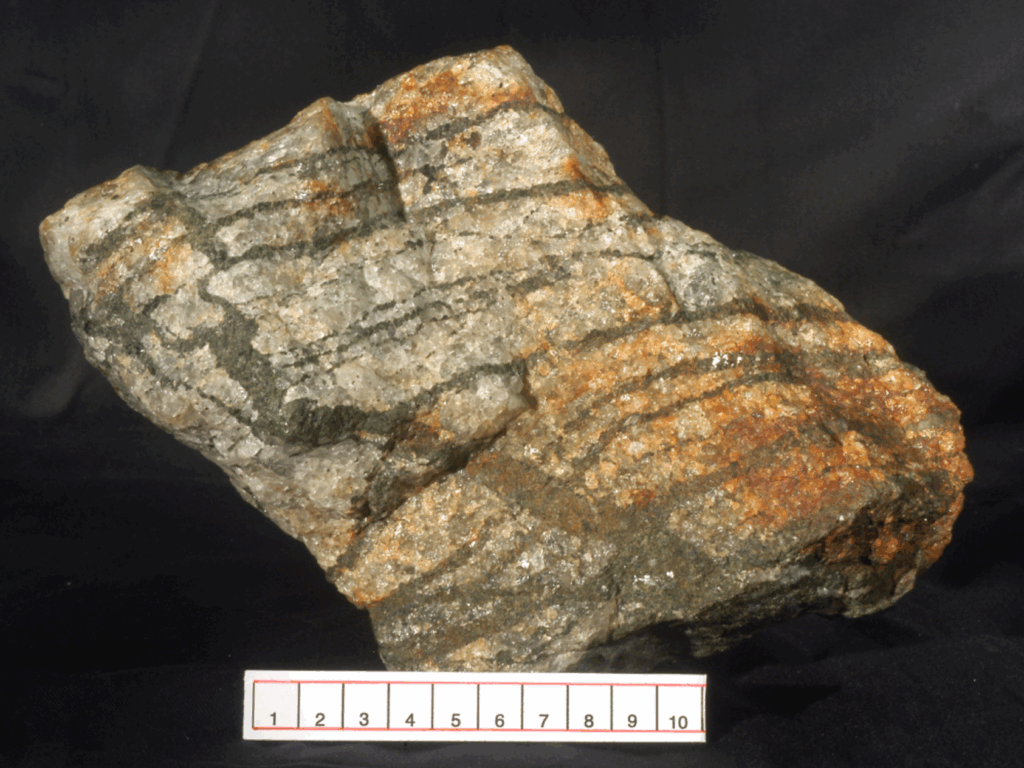
But is it so? Let’s consider the Mojzsis et al. (1996) example (full disclosure: I’m a co-author), who reported δ13C = -37±3‰ (i.e., -3.7%) in graphite inclusions within apatite crystals in a >3.83 billion year old metachert (see Manning et al., 2006 for the definitive geologic history of this enclave). They interpreted the apatites to be “authigenic”, meaning that they formed in sedimentary deposits that may have held life. Those deposits became chert, a silica rock, that then underwent high grade metamorphism (hence, “metachert”). The adjacent picture shows the Akilia metachert. Prominent are dark cross cutting pyroxenite veins which Geology 101 tells us must have been emplaced into the prominent magnetite (black)/quartz (light) layers after they were formed.
Measurements of the δ13C of kerogen (organic goo) in low grade metasediments over the last 3.5 billion years averages -25‰ (Schopf, 2014; Krissansen-Totton et al., 2015), compared to inorganic carbon at 0‰ Thus Mojzsis et al. (1996) concluded that “Unless some unknown abiotic process exists which is able both to create such isotopically light carbon and then selectively incorporate it into apatite grains, our results provide evidence for the emergence of life on Earth by at least 3,800 Myr”. They emphasized that, once graphite forms, the extremely slow diffusion of C in its structure and subsequent encapsulation in apatite essentially precludes the possibility of subsequent exchange of carbon isotopes. That would rule out alternative (2).
So, how did those Heroic Scientists identified by the National Academies smite this claim from the Fall Guys who “lacked the recognition” of possible alternative explanations of the measurements? Well, van Zuilen et al. (2002, 2003) reported that decomposition of siderite to form graphite creates average δ13C signatures of about -15‰.
Now, even the non-expert can see that this number is shy of what typical biological processes have evidently produced to be delivered to kerogen; -15‰ is smaller than -25‰, and still smaller compared to the -37 ‰ measured in the Akilia inclusions (recognizing that the very low δ13C seen in the Akilia apatites might reflect both biogenicity and alteration; e.g., Zeichner et al., 2024).
You might be surprised to learn that van Zuilen et al. (2002) agreed that their study has no bearing the question of Akilia biogenicity. To wit: “…the origin of graphite and apatite-graphite association in Isua cannot, without additional petrographic and chemical analyses, be applied to the more extensively metamorphosed rocks from Akilia island”. But what about van Zuilen et al. (2003)? They added that “…the mechanism for low δ13C of graphite inclusions in apatite (Mojzsis et al., 1996) currently remains unexplained”.
These quantitative facts are absent from the Decadal Survey and, perhaps, from the thinking of its authors. Yet if one reads the original papers (and not the reviews of those papers), it remains quite possible that the δ13C ratio on these samples might indicate signs of life at 3.8 Ga. But if one reads only the Decadal Survey, one knows only of an authoritative statement that this biological interpretation has been excluded.
Now, I have no quarrel with the moral that this morality tale is constructed to support; that geological context is useful when deciding one’s confidence in the assessment of a potential biosignature. To be sure, claims of evidence of the timing of abiogenesis are as subject to intense scrutiny as any open question in science and maybe more. However setting up a morality tale that misrepresents facts is the process by which science is undone.
But the story does not end here. There’s something about the Akilia metachert that seems to bring wingnuts out of the woodwork.
About 10 years after the publication of Mojzsis et al. (1996), two papers, Lepland et al. (2005) and Nutman and Friend (2006) were published that contradicted its basic factual assertion (the former containing the very same authors of van Zuilen et al, 2002). These papers claimed that graphite inclusions are not present in apatites within the Akilia metachert at all. These were remarkable claims. Indeed, in 2005 Stephen Moorbath wrote a News & Views article for Nature in which he adopted Lepland et al.’s (2005) assertion that the rock investigated by Mojzsis et al. (1996) was free of graphite and wrote: “This persuasive discovery [i.e., the absence of graphite] seems an almost inevitable, yet highly problematic, consequence to the increasing scientific doubts about the original claim. We may well ask what exactly was the material originally analysed and reported? What was the apatite grain with supposed graphite inclusions that figured on the covers of learned and popular journals soon after the discovery? These questions must surely be answered and, if necessary, lessons learned for the more effective checking and duplication of spectacular scientific claims from the outset.”
Here, the back-and-forth that is so important in science played itself out. McKeegan et al. (2007) used a combined Raman imaging-ion microprobe carbon isotope analysis approach to image graphite included in an apatite crystal within the quartzite from the original metachert sample. By careful polishing, they were able to bring that carbon inclusion to within 1 µm of the polished surface. They measured its δ13C to be -29‰±4‰. This appeared to incontrovertibly demonstrate the presence and primary nature of graphite inclusions with light carbon isotope compositions in Akilia apatites. They concluded that their results are “consistent with the hypothesis that graphite-containing apatite grains of the older than 3830 Ma Akilia metasediments may represent chemical fossils of early life”. Although neither Lepland et al. (2005) or Nutman and Friend (2006) formally retracted their papers, the publication of McKeegan et al. (2007) appears to have abruptly ended this line of criticism.
Decadal Surveys are important, in part because they inform their lay readers and in part because they guide federal research funding priorities…in this case in astrobiology. For example, the view expressed in the 2013 decadal survey that Martian soils are today self-sterilizing, persisting from misinterpretations of the Viking mission data, may have prevented the search for extant Martian life for a decade.
Thus, Decadal Surveys do damage when their authors do not follow one of the first lessons that we teach our students: “Read the papers, not the reviews of the papers”. Comprehensive studies of the most ancient putative Terran organic materials have not been funded for some time. NASA, in its Interdisciplinary Centers for Astrobiology Research, has been chasing the more exciting realm of exoplanets. One wonders whether such flaws in the Decadal Surveys provide some of the explanation as to why.
As we look with alarm at this moment of rapidly declining trust in science and scientists, I note the conclusion of Barnes et al. (2018) that attacks falsely implying scientific misconduct have the same negative impact on attitudes towards science claims as direct attacks on the empirical basis of those claims. Let’s not use the few opportunities we have to rally our scientific community around a shared vision of the future to plant false rumors and sow discord, and in doing so give sustenance to the crazies who would love to see the scientific enterprise derailed.
References
Barnes, R.M., Johnston, H.M., MacKenzie, N., Tobin, S.J. and Taglang, C.M. (2018) The effect of ad hominem attacks on the evaluation of claims promoted by scientists. PloS one 13, p.e0192025.
Harrison, T.M. and Benner, S.A. (2022) NASA’s “Standards” White Paper. Does NASA’s drive for consensus make young scientists susceptible to being trampled by mastodons? Primordial Scoop e20220525. https://doi.org/10.52400/DVGO6088.
Krissansen-Totton, J., Buick, R., & Catling, D. C. (2015) A statistical analysis of the carbon isotope record from the Archean to phanerozoic and implications for the rise of oxygen. American Journal of Science 315, 275-316.
Lepland, A., van Zuilen, M.A., Arrhenius, G., Whitehouse, M.J., and Fedo, C.M. (2005) Questioning the evidence for Earth’s earliest life – Akilia revisited. Geology 33, 77–79.
McKeegan, K.D, Kudryavtsev, A.B., and Schopf, J.W. (2007) Raman and ion microscopic imagery of graphitic inclusions in apatite from older than 3830 Ma Akilia supracrustal rocks, west Greenland. Geology 35, 591-594.
Manning, C.E., Mojzsis, S.J. and Harrison, T.M. (2006) Geology, age constraints, and supracrustal origin of SW Akilia Island, West Greenland. Am. J. Sci. 306, 303-366.
Mojzsis S.J., Arrhenius, G., McKeegan, K.D., Harrison, T.M., Nutman, A.P., and Friend, C.R.L. (1996) Evidence for life on Earth by 3800 Myr. Nature 384, 55-59.
Moorbath, S. (2005) Palaeobiology: Dating earliest life. Nature 434, 155-156.
National Academies of Sciences, Engineering, and Medicine. 2023. Origins, Worlds, and Life: A Decadal Strategy for Planetary Science and Astrobiology 2023-2032. Washington, DC: The National Academies Press. https://doi.org/10.17226/26522.
Nutman, A.P. and Friend, C.R. (2006) Petrography and geochemistry of apatites in banded iron formation, Akilia, W. Greenland: Consequences for oldest life evidence. Precambrian Research 147, 100-106.
Schopf, J.W. (2014) Geological evidence of oxygenic photosynthesis and the biotic response to the 2400-2200 Ma “Great Oxidation Event”. Biochem. (Moscow) 79, 165-177.
Schidlowski, M., P.W.U. Appel, R. Eichman, and C.E. Junge (1979) Carbon Isotope Geochemistry of the 3.7×10⁹-Yr-Old Isua Sediments, West Greenland: Implications for the Archaean Carbon and Oxygen Cycles.” Geochimica et Cosmochimica Acta 43, 189–199.
van Zuilen, M.A., Lepland, A. and Arrhenius, G. (2002) Reassessing the evidence for the earliest traces of life. Nature 418, 627-630.
van Zuilen, M.A., Lepland, A., Teranes, J., Finarelli, J., Wahlen, M. and Arrhenius, G. (2003) Graphite and carbonates in the 3.8 Ga old Isua supracrustal belt, southern West Greenland. Precambrian Research 126, 331-348.
Zeichner, S.S., Fischer, W.W., Lotem, N., Moore, K.R., Goldford, J.E. and Eiler, J.M. (2024) The carbon isotopic composition of Archean kerogen and its resilience through the rock cycle. American Journal of Science 324, p.8.
Acknowledgements: I thank Steve Benner for his tremendously helpful comments on the first draft of this article.