Searching for sunlight induced fluorescence on Venus

Searching for sunlight induced fluorescence on Venus

In our 2026 study, Venus’s strong cloud absorption was found to be consistent with concentrated organic pigments. If the pigments are organic, sunlight absorbed by them could be returned as fluorescence. On Earth, fluorescence from plants and ocean plankton is detected through the partial filling of dark solar absorption lines. Public Venus spectra from four instruments, including Hubble’s spectrograph, were examined for the same effect. Line filling was found after several reference and instrumental checks, consistent with broad fluorescence. The observations and calculations are presented here, together with proposed measurements through which fluorescence and its possible connection to cloud life could be tested.

From the surface to the clouds: A dark evolutionary history of hypothetical life in Venus’s clouds

From the surface to the clouds: A dark evolutionary history of hypothetical life in Venus’s clouds

Attempts to transplant any known Earth life into the clouds of modern Venus would be fatal. Intense UV and concentrated sulfuric acid aerosols would kill most organisms. Even the sturdiest survivors would eventually settle below the clouds and undergo pyrolysis at temperatures incompatible with organic chemistry. The jump to Venus is impossible for life as we know it, but a gradual transition might have allowed survival through evolutionary adaptation, producing a thriving cloud ecosystem that may have smothered ground-dwelling life. This final post in the Venus cloud life series argues that life in Venus’s clouds today should be considered a realistic possibility: there may be no unsurmountable obstacle to its existence.
The case for extant life on Mars: A Technical Reanalysis of the Viking Carbon Assimilation–Pyrolytic Release Experiment

The case for extant life on Mars: A Technical Reanalysis of the Viking Carbon Assimilation–Pyrolytic Release Experiment

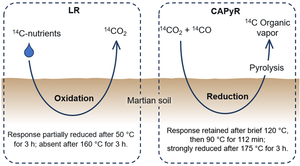
Our reanalysis revisits Viking Carbon Assimilation–Pyrolytic Release experiment, which tested whether Martian soil incorporated carbon from supplied gases into organic material. Seven of nine usable runs produced significant positive signals, including one conducted in darkness. We examine why these results were dismissed, how perchlorate could have obscured part of the signal, and why proposed mineral explanations still fail to reproduce the full experimental pattern. Taken together with the Labeled Release results, the observations suggest that Martian soil both oxidized organic nutrients and fixed carbon from CO and/or CO₂ gases—a combination typical of a microbial community, whose experimental responses no known mineral chemistry has yet reproduced.
Hypothesis: Venus clouds host a large biosphere

Hypothesis: Venus clouds host a large biosphere

In our recent Astrobiology paper we presented a model in which Venus's unknown UV-blue absorber is consistent with a defined, very strong absorber at very high concentration in cloud aerosols. If that absorber is produced by life, the implied biosphere could be large enough to change the mass, chemistry, and physics of the cloud itself. Here I follow that premise through its consequences. Every major claim is phrased as something that can be tested. At this stage I would recommend to read the post as hard science fiction with numbers and interesting figures attached. However, the story fits the Venus observations, and generates explanations to a lot of yet unexplained mysteries.
Autotrophy on Mars (1): Seeking Martian Photosynthesis

Autotrophy on Mars (1): Seeking Martian Photosynthesis

Here I examine Viking’s carbon assimilation (a.k.a. “pyrolytic release”) experiments aimed to detect Martian autotrophy by following labeled carbon from atmospheric CO/CO₂ into soil organics, followed by the release of labeled volatile gases by pyrolysis. These experiments were prone to both false negatives (oxidants burning organics) and false positives (alkaline soils binding CO₂). And yet when taken in context of the current understanding, these results might be the most important in the series of the Viking biological experiments and are worth studying in detail.
Viking Experiments on Mars: Fixing a Half Century of Mistakes

Viking Experiments on Mars: Fixing a Half Century of Mistakes

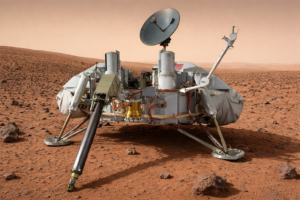
Half a century ago, Viking delivered evidence suggesting metabolically active life on Mars, but its legacy was derailed by a mistaken GC–MS interpretation that shaped Mars exploration for decades. This is the firsts article in a series that reexamines Viking’s experiments and results from primary data, shows how they were (mis)interpreted, and that suggests life-finding strategies.
Martian water management with biofilm slimes, a speculation.

Martian water management with biofilm slimes, a speculation.

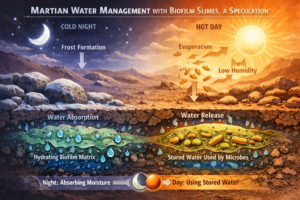
Martian life is exposed to many stressors at once, but temperature and water availability dominate because they jointly decide whether chemistry can run in a liquid solvent. Warm periods exist, yet they coincide with brutal daytime drying. I argue that a plausible loophole is not only “finding” deliquescent niches, but extending them: microbes could store night moisture inside extracellular matrix (biofilm) and use that stored water during the warm daytime window, enabling faster metabolism.
IMPRESS to Deliver Art and Science to Mars

IMPRESS to Deliver Art and Science to Mars

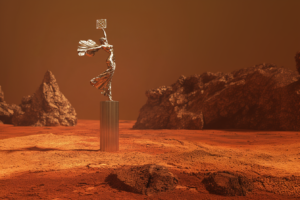
The image depicts a concept art: a five meters tall titanium penetrator imbedded in the Martian soil. The scientific payload and cameras broadcasting statue's selfies reside in the half-buried pedestal. Long after the science mission ends, this statue will serve as a landscape feature and a message to the future generations.