The case for extant life on Mars: A Technical Reanalysis of the Viking Carbon Assimilation–Pyrolytic Release Experiment

The case for extant life on Mars: A Technical Reanalysis of the Viking Carbon Assimilation–Pyrolytic Release Experiment

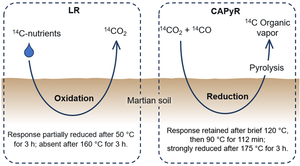
Our reanalysis revisits Viking Carbon Assimilation–Pyrolytic Release experiment, which tested whether Martian soil incorporated carbon from supplied gases into organic material. Seven of nine usable runs produced significant positive signals, including one conducted in darkness. We examine why these results were dismissed, how perchlorate could have obscured part of the signal, and why proposed mineral explanations still fail to reproduce the full experimental pattern. Taken together with the Labeled Release results, the observations suggest that Martian soil both oxidized organic nutrients and fixed carbon from CO and/or CO₂ gases—a combination typical of a microbial community, whose experimental responses no known mineral chemistry has yet reproduced.
Budding life in the clouds of Venus

Budding life in the clouds of Venus

If Venus’s clouds host life, reproduction must replace organisms lost into the hot atmosphere below. Here I explore budding living aerosols whose mothers retain waste while releasing daughters, drawing on the biology of budding yeast. Illustrative calculations estimate how much reproduction could occur before each mother leaves the cloud, and explore how these life cycles could preserve lineages and affect Venus’s atmospheric sulfur budget.
Hypothesis: Venus clouds host a large biosphere

Hypothesis: Venus clouds host a large biosphere

In our recent Astrobiology paper we presented a model in which Venus's unknown UV-blue absorber is consistent with a defined, very strong absorber at very high concentration in cloud aerosols. If that absorber is produced by life, the implied biosphere could be large enough to change the mass, chemistry, and physics of the cloud itself. Here I follow that premise through its consequences. Every major claim is phrased as something that can be tested. At this stage I would recommend to read the post as hard science fiction with numbers and interesting figures attached. However, the story fits the Venus observations, and generates explanations to a lot of yet unexplained mysteries.
Martian water management with biofilm slimes, a speculation.

Martian water management with biofilm slimes, a speculation.

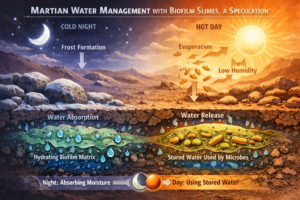
Martian life is exposed to many stressors at once, but temperature and water availability dominate because they jointly decide whether chemistry can run in a liquid solvent. Warm periods exist, yet they coincide with brutal daytime drying. I argue that a plausible loophole is not only “finding” deliquescent niches, but extending them: microbes could store night moisture inside extracellular matrix (biofilm) and use that stored water during the warm daytime window, enabling faster metabolism.
IMPRESS to Deliver Art and Science to Mars

IMPRESS to Deliver Art and Science to Mars

The image depicts a concept art: a five meters tall titanium penetrator imbedded in the Martian soil. The scientific payload and cameras broadcasting statue's selfies reside in the half-buried pedestal. Long after the science mission ends, this statue will serve as a landscape feature and a message to the future generations.
Radiation on Mars is less likely to kill you than sitting on your couch

Radiation on Mars is less likely to kill you than sitting on your couch

We have all heard that radiation on the Martian surface is dangerous to humans and that it would limit the extent of life there, both indigenous and transplanted. However, what is rarely mentioned is how dangerous the radiation is exactly. I will attempt to quantify this danger. In short: If you choose to forgo exercise and have a poor diet, you have a higher chance of premature death due to cancer than if you lead an otherwise healthy life but are exposed to Mars-surface radiation levels.
Evolution is cleverer than you are

Evolution is cleverer than you are

Biology is very difficult to predict but surprisingly easy to bend to fit any observed results. Life on Mars might employ various pathways to generate energy and fix reduced carbon. Contrary to Steven Benner's claims, at least some of the potential pathways do not involve the generation of molecular oxygen.
Interplanetary lawn darts to study extant life in Martian subsurface ice

Interplanetary lawn darts to study extant life in Martian subsurface ice

A proposal to search for life on Mars using kinetic penetrators, embedding probes into Martian ice through hard landing. This life-finding mission concept is low-cost and accessible to many private organizations, allowing to seek and study Mars biosphere by multiple entities before we send humans there.