Autotrophy on Mars (4): What Next?

Autotrophy on Mars (4): What Next?

What should we do with a 50-year-old life-detection experiment whose signal was real, but whose interpretation remains tangled in false positives, false negatives, and missing follow-up work? This article lays out the unresolved weaknesses in Viking’s HHH carbon-fixation results, then turns the problem into a set of concrete astrobiology challenges—suggesting how Earth-based tests and a modern IMPRESS-style instrument could finally clarify whether Mars once gave us a genuine sign of autotrophic life.
Autotrophy on Mars (3): How Data Lost Out to the “Community Consensus”

Autotrophy on Mars (3): How Data Lost Out to the “Community Consensus”

Did Viking’s carbon-assimilation experiment actually detect evidence of Martian autotrophy—only to have that result buried beneath a later “community consensus” that declared Mars lifeless? This article revisits the Horowitz–Hobby–Hubbard data, argues that the life-positive signal was real and logically never refuted, and traces how GC-MS interpretations came to outweigh contradictory evidence in the story of Viking.
Autotrophy on Mars (2): Viking Detects Martian “Photosynthesis”

Autotrophy on Mars (2): Viking Detects Martian “Photosynthesis”

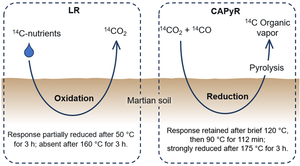
Viking’s carbon assimilation experiment was designed to detect whether Martian soil could fix labeled inorganic carbon (¹⁴CO₂/¹⁴CO) into “higher” organic matter, and it returned a small but statistically significant signal in the fraction interpreted as newly formed organics. However, the results were dominated by a much larger labeled CO₂/CO release that bypassed the organic trap (the “Peak 1” anomaly), raising the possibility of false positive results due to adsorption or carbonate chemistry.
Autotrophy on Mars (1): Seeking Martian Photosynthesis

Autotrophy on Mars (1): Seeking Martian Photosynthesis

Here I examine Viking’s carbon assimilation (a.k.a. “pyrolytic release”) experiments aimed to detect Martian autotrophy by following labeled carbon from atmospheric CO/CO₂ into soil organics, followed by the release of labeled volatile gases by pyrolysis. These experiments were prone to both false negatives (oxidants burning organics) and false positives (alkaline soils binding CO₂). And yet when taken in context of the current understanding, these results might be the most important in the series of the Viking biological experiments and are worth studying in detail.
Viking Experiments on Mars: Fixing a Half Century of Mistakes

Viking Experiments on Mars: Fixing a Half Century of Mistakes

Half a century ago, Viking delivered evidence suggesting metabolically active life on Mars, but its legacy was derailed by a mistaken GC–MS interpretation that shaped Mars exploration for decades. This is the firsts article in a series that reexamines Viking’s experiments and results from primary data, shows how they were (mis)interpreted, and that suggests life-finding strategies.
Martian water management with biofilm slimes, a speculation.

Martian water management with biofilm slimes, a speculation.

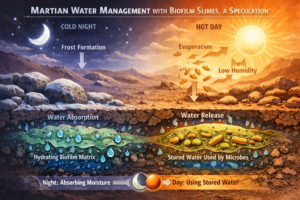
Martian life is exposed to many stressors at once, but temperature and water availability dominate because they jointly decide whether chemistry can run in a liquid solvent. Warm periods exist, yet they coincide with brutal daytime drying. I argue that a plausible loophole is not only “finding” deliquescent niches, but extending them: microbes could store night moisture inside extracellular matrix (biofilm) and use that stored water during the warm daytime window, enabling faster metabolism.
NASA DARES to Establish an Astrobiology-Specific Technology Development Program

NASA DARES to Establish an Astrobiology-Specific Technology Development Program

NASA’s Science Mission Directorate, Planetary Science Division, Space Technology Mission Directorate, and Astrobiology Program are recommended by the Agnostic Life Finding Association (ALFA) to establish a competitive, highly-focused, science-requirements-driven technology development program to advance astrobiological instrumentation towards and beyond Technology Readiness Level (TRL) 6.
Searching for Unambiguous Signs of Extant Life on Mars with the Agnostic Life Finder (ALF)

Searching for Unambiguous Signs of Extant Life on Mars with the Agnostic Life Finder (ALF)

NASA’s Science Mission Directorate (SMD) and Mars Exploration Program (MEP) are recommended by the Agnostic Life Finding Association (ALFA) to produce a focused investigation to seek unambiguous signs of extant life within the Martian subsurface ice, in this decade, by deploying the Agnostic Life Finder (ALF) in concordance with planned water-mining operations on Mars.
How to Search for Unambiguous Signs of Extant Life on Mars with NASA-DARES 2025

How to Search for Unambiguous Signs of Extant Life on Mars with NASA-DARES 2025

NASA’s Science Mission Directorate (SMD) and Mars Exploration Program (MEP) are recommended by Agnostic Life Finding Association (ALFA) to produce a focused investigation to seek unambiguous signs of extant life within the Martian subsurface ice, in this decade, as a Discovery-class mission or by deploying an astrobiology payload in concordance with planned water-mining operations on Mars.
Prioritize the Search for Extant Life on Mars with NASA-DARES 2025

Prioritize the Search for Extant Life on Mars with NASA-DARES 2025

NASA’s Science Mission Directorate (SMD) and Mars Exploration Program (MEP) are hereby recommended by Christopher Temby and Agnostic Life Finding Association to ensure that the highest priority science objective in the coming decade for the 2025 Decadal Astrobiology Research and Exploration Strategy (NASA-DARES 2025) is a search for an extant Martian biosphere before human arrival.
IMPRESS to Deliver Art and Science to Mars

IMPRESS to Deliver Art and Science to Mars

The image depicts a concept art: a five meters tall titanium penetrator imbedded in the Martian soil. The scientific payload and cameras broadcasting statue's selfies reside in the half-buried pedestal. Long after the science mission ends, this statue will serve as a landscape feature and a message to the future generations.