

This is the first of three planned posts examining a working hypothesis: that a biosphere forms a significant part of Venus’s clouds, constitutes a substantial fraction of their mass, alters atmospheric chemistry and cloud physics, absorbs solar energy, and—at least to some degree—turns the cloud system itself into an extended phenotype of Venusian life.
This first post stays at the planetary scale: cloud composition and mass, atmospheric chemistry, sulfuric-acid production, particle cycling, and atmospheric retention. The second post will treat an individual Venus cloud droplet as a biological unit. The third will sketch a plausible evolutionary pathway from an ocean world to a biologically sustained cloud system that ultimately helped smother surface life, completing this rather dark science-fiction trilogy.
Because these posts examine the biological hypothesis, I will refer to the unknown absorber residing in Venus’s cloud aerosols simply as the “pigment.”
What prompted the large biosphere hypothesis?
In Venus Revealed (1997), David Grinspoon proposed that the unknown ultraviolet absorber could be a photosynthetic pigment. A later review summarized his proposal as one of several possible biological interpretations of the Venus clouds (Limaye et al., 2018). Grinspoon has since described the absorber as appearing and disappearing almost like algal blooms in an ocean. At the time the idea sounded extravagant. Now, this blog post provides strong support for it.
My own reaction was initially also very negative. When I was invited in 2021 to run laboratory experiments on organic chemistry in concentrated sulfuric acid, I considered biology in concentrated sulfuric acid as a crazy idea. But the more time I spent studying the Venus cloud, the more chemically plausible the idea of life in sulfuric acid seemed (see Are Venusians ‘Life’?). The 2021 carbon-cycle preprint laid out a way for organic carbon to be processed and recycled through the Venus atmosphere (Spacek, 2021). Laboratory work funded in part by the Breakthrough Foundation then showed the mechanism how photochemically generated carbon compounds can react in concentrated sulfuric acid to produce larger, colored, and fluorescent organic material (Spacek et al., 2023). Couple years ago I still argued for the Venus Life Finder team to adopt a more conservative name, welcoming the proposed Morning Star Missions. Perhaps I was too hasty.
Couple years of heating various organics in concentrated sulfuric acid, and supervising Gage Owens, Victor Moncada, Spencer Cady, and Daisy Sharma – students working on the project, gave me empirical intuition: I could roughly estimate how much of initially colorless organics were added to a mixture to produce the resulting hue (Fig. 1). The 0.14 mM inventory of organics predicted by our model (Spacek et al., 2023), seemed too little to reconcile with observations that the Venus absorber is responsible for about half of the solar energy absorbed by the planet (Titov et al., 2018).
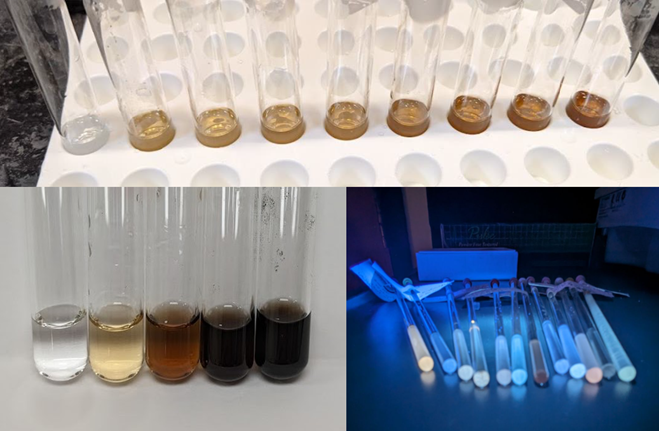
Figure 1. Top: 10 mg/ml of formaldehyde heated for 0-120 min at 120 °C in 80% sulfuric acid “evolves” to give yellow/brownish mixture of fluorescent tar – or ‘red oil’. Lower concentrations of initial organics produce lighter coloration. Bottom left: longer time series proceed towards brown and black over hours. Bottom right: depending on the exact treatment and initial composition formaldehyde “evolves” to give multiple products providing florescence at different wavelengths. Similar behavior, gradual conversion to colored fluorescent material, has been observed with most of tested organics (Moncada et al, 2024).
To compare our lab work with remote observations, I asked the audience of Venus experts at a 2023 conference what’s the color of the Venus’s cloud liquid (Spacek et al., 2023). To my surprise nobody knew the answer, however Dr. Yeon Joo Lee suggested that she should be able to model it.
Thus, we examined a quantitative laboratory-style question: if the cloud liquid could be collected into a cuvette and put into a spectrometer, how strongly would that bulk liquid have to absorb light to reproduce the observed Venus albedo? My intended goal was to to bridge the gap between remote astronomical observations and laboratory experiments.
Under the assumption that the absorber resides in the aerosols, the surprising result is that Venus cloud liquid must be extremely absorbing in the UV-blue (Spacek et al., 2026). The proposed inorganic absorbers struggle to fit the model. Defined organics in the form of efficient chromophores can reach the required absorption only if present at considerable concentrations: the required concentration of the Venus’s cloud pigment is comparable to concentrations of chlorophyl in grass. Truly striking result. That was the motivation for taking the biological version of the idea seriously enough to publish the optical calculation in Astrobiology (Spacek et al., 2026). The paper constraints the UV absorber properties. The jump that the Venus absorber is biological pigment suggesting a massive biosphere and the exploration what does the assumption imply is done here.
1. How much material would a biological pigment imply?
Our final 2026 absorber model gives a decadic bulk-liquid absorption coefficient at 375 nm of 1,278 cm-1. The true maximum may lie at shorter wavelength (Pérez-Hoyos et al., 2018), but I use the directly constrained 375-nm value here. An efficient conjugated absorber with a molar absorption coefficient of 105 M-1 cm-1 and molecular mass of 1000 g/mol (modeled after chlorophyll-type absorber) would need to occur at 12 g/L of cloud liquid. This is an efficiency benchmark cannot be used to identify the structure of the Venus’s pigment (Spacek et al., 2026).
A biological pigment would normally represent only part of an organism. Terrestrial phytoplankton total carbon to carbon in chlorophyll ratios vary by roughly an order of magnitude within and among environments, and commonly lie in the broad domain of tens to hundreds of grams of cellular carbon per gram of chlorophyll carbon (Xiu & Chai, 2012; Graff et al., 2015). For the working hypothesis scale assumption, I will use the value of 0.50 kg of biological carbon per liter of cloud aerosol.
A working whole-cloud mass
The updated working calculation starts from the Baines et al. (2021) cloud table, which in turn derives aerosol loading from the Pioneer Venus particle-size measurements of Knollenberg and Hunten (1980). Baines et al. summarize the 46-70 km aerosol burden as about 22 mg/cm2 = 0.22 kg/m2 (Baines et al., 2021). The table itself labels the cumulative column as H2SO4 mass and separately lists acid weight fraction. Following that label, the working calculation corrects each altitude layer for its H2SO4 fraction. The 21.94 mg/cm2 acid column becomes 23.72 mg/cm2 of total H2SO4-H2O solution, corresponding to about 109 Gt globally.
Using a representative liquid density of 1.8 kg/L, the 109-Gt working cloud contains about 60.7 km3 of dispersed aerosol liquid. If 12 g/L of pigment were present throughout that entire volume, the pigment inventory would be about 0.73 Gt. Applying the separate 0.50 kg C/L biological scaling gives about 30 Gt of biological carbon, or roughly 60 Gt dry biomass if Venus organisms had an Earth-like dry-mass carbon fraction. At the same loading, the illustrative pigment is about 2.4% of the carbon mass concentration.
To illustrate the scale of a 30-Gt biological-carbon inventory: the hypothetical Venus cloud biosphere would contain roughly a hundred times more living carbon than the standing carbon biomass of all phytoplankton on Earth. (Stoer and Fennel, 2024).
| Working-estimate note. The 109-Gt cloud mass inherits Pioneer Venus assumptions about particle shape and density, and much of the inferred lower-cloud mass depends on the debated Mode-3 population. Knollenberg & Hunten used 2.0 g cm-3; using that density would lower the per-liter carbon inventory to about 27.3 Gt C. Toon et al. questioned whether Mode 3 was a separate population, while Knollenberg defended it, and later VEGA results showed a different deep-cloud distribution. The modern review emphasizes strong spatial and temporal variability (Knollenberg & Hunten, 1980; Toon et al., 1984; Knollenberg, 1984; Titov et al., 2018). |
Working numbers used in this post
| Quantity | Working value | What it means |
| Efficient pigment concentration | ~12 g/L | Optical concentration for a very strong defined chromophore in the 2026 model. |
| Biological carbon loading | 0.50 kg C/L | Pigment-rich terrestrial-style scaling; real C:pigment ratios vary by about order of magnitude around the selected value. |
| Global aerosol burden | ~109 Gt | Working reconstruction of the Baines/Pioneer column after acid-fraction correction. |
| Cloud liquid volume | ~60.7 km^3 | Uses 1.8 kg/L as the representative liquid density. |
| Whole-cloud pigment inventory | ~0.73 Gt | Requires extrapolating the ~12 g/L concentration through the full working cloud volume. |
| Standing biological carbon | ~30 Gt C | Central whole-cloud working hypothesis; ~27.3 Gt C if 2.0 kg/L density is used. |
The whole-cloud extrapolation is the largest assumption
The 2026 optical model directly constrains an upper-cloud absorbing layer. It does not suggest 12 g/L throughout 46-70 km. The whole-cloud biomass number assumes that absorber-bearing material of similar concentration is present through much of the cloud and can be carried upward from deeper layers. The old in-situ record gives a reason to test this instead: VEGA active UV spectroscopy detected a separate absorber “X” in and below the lower cloud, including three absorbing layers between about 49 and 43 km (Bertaux et al., 1996). That X material was not shown to be the same substance that darkens the upper cloud. It does show that unexplained UV-absorbing material can exist much deeper than the cloud top and is consistent with a model where organic carbon that is not volatilized dries and falls from the cloud (Fig. 2) (Spacek, 2021).
| Testable hypothesis. Measure the vertical concentration and composition of the pigment. If the 365-455 nm pigment is confined to a thin upper layer, the 30-Gt whole-cloud carbon estimate collapses proportionally. If deep and upper absorbers share composition or chemical ancestry, the whole-cloud interpretation gains support. A large organic mass fraction should also alter refractive index, density, viscosity, particle shape, settling, and phase behavior enough to be detectable in reanalysis of Pioneer Venus, Venera, and VEGA data and eventually by direct aerosol composition measurements. |
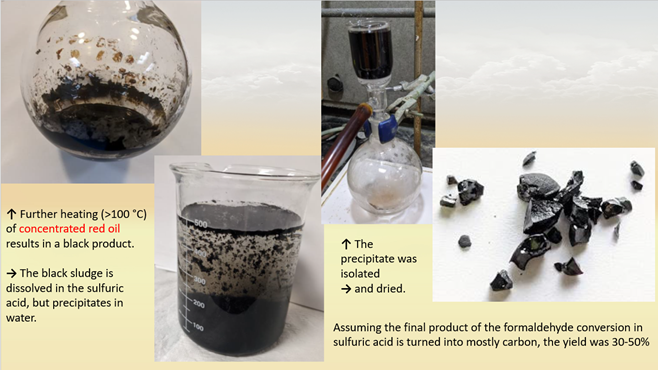
Figure 2. Progression of tar (or red oil) generated from formaldehyde in heated sulfuric acid beyond products shown in Figure 1. Regardless what is the initial source of the organic carbon in the clouds, the dry black product would be falling from the cloud, forming the lower haze (Spacek, 2021).
A chiral optical test
The strongest remote biological test may have nothing to do with molecular identification. Homochiral biological pigments and pigment-protein assemblies can imprint wavelength-structured circular polarization on reflected light. Sparks and colleagues detected such signals from photosynthetic microorganisms and later showed a wide diversity of circular spectropolarimetric signatures from oxygenic and anoxygenic phototrophs; their 2021 discussion explicitly lists the clouds of Venus as a possible Solar System target (Sparks et al., 2009; Sparks et al., 2021).
This gives the hypothesis an optical prediction already stated in our 2026 paper: if the Venus pigment is chiral organic material and produces a circular-polarization feature in reflected light, that would be a strong indication of biological origin (Spacek et al., 2026). A practical experiment would measure the circular Stokes component, V/I, as a function of wavelength across the pigment absorption bands. Biology is expected to produce structured features tied to molecular absorption; ordinary multiple scattering can also generate circular polarization, but tends to be weaker and spectrally smoother.
| Testable hypothesis. Obtain high-sensitivity circular spectropolarimetry of UV-dark and UV-bright Venus regions. A repeatable, absorption-band-correlated circular-polarization spectrum that tracks the unknown pigment would be much harder to explain with an achiral inorganic absorber. A null result would constrain the fraction, organization, and enantiomeric excess of any chiral biological material. |
2. A carbon-sulfur redox cycle could both build biomass and make sulfuric acid
A large organic reservoir in Venus’s oxidized atmosphere requires considerable reducing power: carbon must move from CO2 toward the oxidation state of organic matter. Incidentally, Venus also suffers from an opposing problem: SO2 is abundant below the clouds and depleted by orders of magnitude through and above them, while sulfur ends up in more oxidized forms including sulfate and sulfuric acid. Known photochemistry performs part of this oxidation, yet full-atmosphere models retain important mismatches in sulfur-species profiles (Bierson & Zhang, 2020). Rimmer and colleagues emphasized that the simultaneous SO2 and H2O depletion between roughly 45 and 65 km cannot be reproduced from known gas-phase chemistry and the observed atmospheric composition alone (Rimmer et al., 2021).
The working biological idea couples the two redox directions in one bookkeeping reaction:

Oxidizing two sulfur atoms from S(IV) to S(VI) supplies four electrons, enough to reduce one carbon from CO2 toward an average oxidation state zero. Biomass that contains more hydrogen requires additional water, so the exact equation depends on what Venus biomass is made of. A Venus biochemistry also need not be carbohydrate-rich. It is well known (and I’ve observed many times) that carbohydrates are rapidly dehydrated in concentrated sulfuric acid. Thus acid-compatible biochemistry may favor very different functional groups, potentially including ketone-, ester-, sulfoxide-, or sulfone-rich structures. The molecular biology of Venus’s life will be further discussed in the follow-up post.
The working idea is that the reaction would be driven by light. A balanced redox equation by itself does not establish kinetics or usable metabolic free energy for reaction in sulfuric acid aerosols. I therefore treat the photosynthesis analogy as a hypothesis: the actual Gibbs-energy budget, activities of dissolved gases, protonation states, and reaction pathway in concentrated sulfuric acid still need to be calculated and measured.
Using the working stoichiometry, building the ~30 Gt C inventory once requires about 320 Gt of SO2 and about 90 Gt of H2O, while producing about 490 Gt of H2SO4. These are working stoichiometric totals from the attached mass-balance calculation. The dense lower atmosphere contains far more SO2 than this, so total SO2 inventory is not the limiting. The much harder question is flux: how fast the atmosphere can deliver SO2 and H2O into the biological zone and how quickly biological carbon is lost from it.
Water makes the stoichiometry harder
The measured below-cloud atmosphere is often summarized as roughly 150 ppm SO2 and 30 ppm H2O, with SO2 falling by several orders of magnitude through the cloud and water declining much less dramatically (Rimmer et al., 2021). The displayed reaction consumes two moles of SO2 and two moles of H2O per carbon atom: a 1:1 molar draw on the two gases. Earth-like hydrogen-rich biomass would require still more water. The unequal observed vertical declines are therefore not consistent with this reaction alone. Recycling, transport, reservoirs inside droplets, and additional chemistry have to be included.
Could the reported cloud O2 be a water-sparing branch of the same biosphere?
The water shortage makes one disputed Venus measurement more interesting. The Pioneer Venus gas chromatograph reported 43.6 ppm O2 at 51.6 km and 16 ppm O2 at 41.7 km. Venera 14 reported an average near 18 ppm O2 between about 35 and 58 km. These measurements have been questioned, and remote observations above the clouds have not established a comparable oxygen abundance. The most useful modern summary therefore treats cloud O2 as an unresolved historical anomaly, of order ~10 ppm, that requires new in-situ confirmation (Johnson & de Oliveira, 2019; Bains et al., 2021).
For the purpose of this hypothesis I will make a strong conditional assumption: suppose the reported cloud-region oxygen is real, and suppose all of that excess oxygen is produced by the biosphere. The detailed biochemistry is discussed in the follow-up post. At the planetary redox level, one conceivable water-sparing branch can be written as a formal sulfuric-acid reduction:

The H2S is assumed to be consumed rapidly inside the biological network through fixation into organic molecules. A compatible carbon-reduction bookkeeping step is:

Adding the two reactions cancels both sulfuric acid and hydrogen sulfide in overall Venus’s carbon fixation reaction:

Per carbon atom, the net bookkeeping is CO2 → C + O2. This is formally equivalent to oxygenic carbon fixation and still requires an external energy source, presumably light. Although these assumptions are very speculative, they allow to examine the core redox balance, in principle, fix carbon without consuming net H2O.
This oxygenic branch has a different planetary role from the acid-forming reaction above. The CO2 + 2 SO2 + 2 H2O pathway produces new sulfuric acid and could help form the cloud. The sulfuric-acid/H2S shuttle regenerates its sulfuric acid and therefore produces no net H2SO4. A real ecosystem could, in principle, contain both branches in different proportions. The first is attractive because it links biology to cloud formation; the second is attractive because Venus is so short of water.
Is there enough reported O2 for a ~30 Gt C biosphere?
The oxygen inventory is surprisingly compatible at the order-of-magnitude level. The net reaction above produces one mole of O2 per mole of fixed carbon. Constructing the working ~30 Gt C standing inventory would therefore accompany about ~81 Gt O2 if the oxygen were retained. This is a working stoichiometric comparison, not an estimate of biological production history.
For comparison, if the historical O2 values were globally representative across an illustrative ~48-60 km cloud layer, then ~10 ppm corresponds to a working inventory of about 60 Gt O2, ~18 ppm to about 110 Gt O2, and ~44 ppm to about 270 Gt O2. The sparse probe measurements do not establish a globally mixed reservoir, so these values should be read only as a scale. Even with that caveat, there is not obviously too little reported oxygen for the massive-biosphere hypothesis; the oxygen coproduct associated with the working carbon inventory lies in the same broad range.
A steady biosphere makes the comparison more constraining. In the working 4-5 year carbon-residence case discussed below, replacing a ~30 Gt C inventory corresponds to roughly 6-8 Gt C/year and therefore about 16-20 Gt O2/year in this oxygenic branch. Maintaining a cloud inventory of tens to a few hundred gigatons of O2 would then require an effective oxygen lifetime of roughly a few years to perhaps ~17 years. In the aggressive one-year biomass-loss case the oxygen source would approach ~80 Gt/year and would require a still shorter atmospheric lifetime. These are working consistency checks. A full photochemical model must determine whether Venus can actually remove oxygen at the required rate without producing an observable excess above the clouds.
Testable hypothesis. If the cloud O2 is biological, oxygen should peak in or near pigment-rich cloud material and decline away from the active layer as chemical sinks act. A descent probe should measure O2 simultaneously with the pigment, SO2, and H2O. The predicted correlation need not be instantaneous because gas transport and oxygen lifetime matter, but a confirmed in-cloud O2 maximum tied to pigment-rich regions would be much more interesting than a single global abundance. Conversely, a robust non-detection of cloud O2, or an abiotic model that reproduces its vertical profile and lifetime, would remove this water-sparing branch from the biological argument.
| Testable hypothesis. Recalculate the full atmospheric reaction network so that SO2 and H2O consumption follows biomass production, with the actual average elemental and oxidation-state composition of a candidate Venus organism. In a future co-located aerosol/gas probe or balloon, regions with more pigment should show a systematically different SO2 and H2O drawdown than pigment-poor regions after transport and altitude are accounted for. In the laboratory, isotopically labeled CO2 as the only carbon source plus SO2 as the proposed electron donor should yield linked sulfur oxidation and labeled reduced carbon if the chemistry is possible abiotically. An efficient abiotic version would weaken the biological interpretation and strengthen the coupled carbon-sulfur chemistry itself. |
3. If life makes H2SO4, life helps form the cloud
The standard Venus picture already has a net chemical source of new sulfuric acid. SO2 is oxidized toward SO3, SO3 reacts with H2O, and H2SO4 vapor is produced mainly in the upper/middle cloud region, with peak production in modern models around roughly 60-66 km. The vapor condenses and contributes new material to cloud droplets (Dai et al., 2022).

At the same time, most of the gross sulfuric-acid motion through the cloud is recycling. Dai et al. distinguish the net photochemical acid-production cycle from a much larger condensation-evaporation loop. Droplets move downward, acid evaporates near the cloud base, much of the vapor diffuses upward again, and it recondenses. In their model this internal cloud cycle is about seven times stronger than the net photochemical H2SO4 production cycle (Dai et al., 2022).

My personal pet peeve is that sulfuric acid evaporations rates at relevant environments are experimentally still very poorly constrained (Tsagkogeorgas et al., 2017). I would like to see experimental demonstration of sulfuric acid evaporation rates under conditions mimicking the lower cloud.
Three quantities to examine
| Quantity | Conventional interpretation |
| Net creation of new H2SO4 | Primarily photochemical oxidation of SO2 in the middle/upper cloud atmosphere. |
| Gross formation and reformation of cloud droplets | Mostly evaporation and recondensation of H2SO4 already circulating through the cloud. |
| Large observed SO2 and H2O depletion through the cloud | Still incompletely reproduced by standard gas-phase photochemistry and the observed atmospheric composition. |
The updated working calculation translates Dai’s cloud-base flux into about 106.4 Gt H2SO4 per year moving downward in condensed particles, or about 108.1 Gt/year of 98.5 wt% cloud solution. Compared with the 109-Gt standing cloud mass, that is a gross cloud-mass cycle of roughly one Earth year. It would be wrong to call this ~100 Gt/year of newly synthesized sulfuric acid. Dai’s adopted net chemical source corresponds in the working conversion to only about 13.5 Gt H2SO4 per year; a higher published benchmark used in earlier models corresponds to about 23.7 Gt/year. The rest of the gross rain is recycled – evaporated/condensed – acid (Dai et al., 2022).
This corrects an important temptation in the biomass calculation. The one-year cloud-acid cycle is not automatically a one-year biomass lifetime. Sulfuric acid evaporates and returns upward. Carbonaceous material may behave differently: it could remain in residual particles, be re-entrained, be reincorporated into droplets, chemically recycle below the cloud, or fall irreversibly into the deep atmosphere. The correct turnover time for the biosphere is therefore the residence time of carbonaceous material in the cloud system.
Two working turnover cases
The aggressive case assumes that biological carbon is lost every time the gross droplet mass crosses the cloud base (Figure 2). A ~30 Gt C standing inventory would then require ~30 Gt C/year of new synthesis. Through the displayed reaction that consumes about 320 Gt SO2 and 90 Gt H2O per year and produces about 490 Gt H2SO4 per year. That acid production is about 4.6 times Dai’s modeled gross cloud-base H2SO4 rainout, so the combination of a 30-Gt biosphere, one-year biological turnover, and this reaction as the sole rebuilding route is internally inconsistent.
A useful second working case asks how slowly carbon would need to turn over for biological H2SO4 production to equal, rather than exceed, the gross acid rainout. The attached calculation gives an effective carbon residence time of about 4-5 years. The corresponding annual resource demand is roughly 70 Gt SO2 and 20 Gt H2O. Even this case would make biology a major sulfuric-acid source: its acid production is several times larger than the conventional net photochemical source used in the same model.
The sulfuric acid generation may be lower, if we account for the O2-generating carbon fixation discussed above.
The real residence time could be longer. Ando et al. estimated characteristic sedimentation speeds around 0.14 mm/s above 60 km and 0.21 mm/s below 55 km for a Mode-1/Mode-2 cloud representation, corresponding to multi-kilometer transit times of order a few years (Ando et al., 2020). Those values show that a multi-year carbon residence is not obviously absurd.
The biological implication is that the biosphere may be a significant additional net chemical source of newly synthesized H2SO4 inside the cloud. The organisms would be doing more than living inside an acid cloud. They would help create its acid. Conventional photochemistry already makes new acid, so the biological source must fit inside the total sulfur and cloud-mass budget. If it does fit, a large biosphere could participate directly in forming and maintaining the Venus cloud deck.
| Testable hypothesis. Build a vertical transport model for a nonvolatile organic/biomass tracer in H2SO4-H2O droplets, tracking evaporation, residual-particle sedimentation, winds, diffusion, re-entrainment, and reincorporation. Test abiotic and biological H2SO4 source against this model and see if they match the observed SO2/H2O dynamics. |
4. Long-term SO₂ and UV variability could be a biosignature
Cloud-top SO2 changes strongly with time. During the Venus Express era, low-latitude cloud-top SO2 declined by roughly an order of magnitude while a retrieved UV-absorber parameter increased over part of the same period (Marcq et al., 2020). Independently, the 365-nm albedo changed by about a factor of two from 2006 to 2017, with modeled low-latitude solar-heating changes of roughly 25-40% (Lee et al., 2019).
The relationship is suggestive and incomplete. Marcq’s simultaneous retrieval is strongest in a shorter-UV regime, while our optical model constrains the 365-455 nm pigment. Atmospheric transport, photochemistry, and dynamics can create time-dependent gas and aerosol changes on their own. A biological algae bloom model interpretation suggests a stronger prediction.
SO₂ resupply → population growth → pigment rises → SO₂ and micronutrient depletion →
resource limitation → collapse → pigment falls → SO₂ recovers
That sequence predicts a phase lag. Cloud-top SO2 would act as a gauge of the competition between upward delivery and in-cloud consumption; the tiny above-cloud reservoir is not the biomass itself. If the pigment tracks a population, the pigment maximum should arrive after the relevant resource pulse, and the timing should recur across independent episodes. Ultimately the limiting nutrients in this cycle might be metals and non-volatile components falling in through meteoric infall.
| Testable hypothesis. Reanalyze historical SO2 and 365-nm records with lagged cross-correlation and with explicit controls for latitude, local time, cloud-top altitude, and circulation. At smaller scales, co-located maps of pigment and SO2 should test whether dark structures are followed by stronger SO2 drawdown. A repeatable SO2-recovery → pigment-growth → SO2-minimum → pigment-maximum → decline sequence would be more informative than a single anticorrelation. |
5. A solar-powered carbon-sulfur conveyor
The upper-cloud reaction is only half of the proposed planetary cycle. In my 2021 carbon-cycle model, organic-rich material sediments into progressively hotter, more concentrated acid. The organics become more aromatic and refractory; when sulfuric acid evaporates or decomposes at ~48 km altitude, dark nonvolatile carbonaceous particles (Fig. 2) fall from the cloud. At still greater temperature, carbon can move back toward atmospheric CO, while sulfur and water are recycled toward the lower atmosphere (Spacek, 2021).
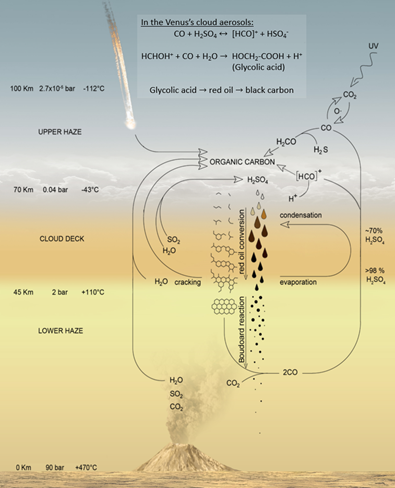
Figure 3. A proposed organic carbon cycle in the atmosphere of Venus as presented in (Spacek et al., 2023), an updated version of the 2021 model.
Accounting for the massive biosphere hypothesis, the complete picture is a vertical conveyor: CO2, CO, SO2, and H2O are transported upward from the lower atmosphere. In the cloud, light-driven carbon fixation and SO2 oxidation produce organic carbon and new H2SO4. Organic-rich droplets and acid move downward. The acid evaporates and recycles efficiently; the carbon either recycles with residual particles, ages into the lower haze, or reaches deeper chemistry that returns it toward CO/CO2. Sulfur returns toward SO2, water is released, and the atmospheric circulation closes the loop.
This is why an inventory of 30 Gt C does not imply that Venus must manufacture 30 Gt C every year. The elemental cycle can close if carbon residence and recycling are long enough. Conversely, if most carbon is irreversibly lost at the cloud base, the flux requirement becomes extreme. Carbon residence is therefore a primary discriminant between a viable planetary biosphere and an attractive mass-balance story.
| Testable hypothesis. A single coupled atmosphere-cloud model must reproduce SO2, H2O, cloud mass, sedimentation, CO/OCS chemistry, and a physically plausible carbon residence-time distribution with one recycling scheme. If the lower haze is recycled biological carbon, its abundance and optical properties should be quantitatively connected to the downward organic flux required by the cloud biosphere. Some of the organic carbon would undergo cracking (pyrolysis) at lower altitude: volatile reduced carbon should be present at higher concentrations below the cloud. |
6. If biology is this abundant, it may seed and restructure the cloud
A ~30-Gt carbon biosphere changes the image of “organisms floating in droplets.” Organic material would be a bulk aerosol constituent. Cells, fragments, extracellular material, volatile metabolites, and carbonaceous residues would provide enormous numbers of surfaces for condensation. On Earth, biological material is an important class of cloud aerosol nuclei. On Venus, a massive biosphere could generate sulfuric acid chemically and simultaneously provide surfaces on which sulfuric acid and water condense.
The lower cloud is especially interesting because much of the working aerosol mass resides there and because the particle distribution is uncertain. If biology adds both nonvolatile organic mass and newly synthesized acid, lower-cloud particle growth may differ from a binary H2SO4-H2O model.
| Testable hypothesis. Rebuild Venus cloud microphysics with an organic fraction comparable to the working biosphere. Calculate how the added material change nucleation, condensation, density, refractive index, viscosity, coalescence, and settling. The model should be compared with particle number, size distributions, lower-cloud mass loading, nonsphericity, and any high-refractive-index populations. If a large organic fraction makes those observations harder to reproduce, the mass premise is weakened. |
7. The pigment may help retain the biosphere by heating the air that carries it
The unknown pigment is a major radiative agent. The upper-cloud absorber is associated with roughly half of the solar energy absorbed by Venus, and UV-dark low latitudes can receive several times more solar energy than UV-bright high latitudes (Titov et al., 2018). The observed long-term albedo changes are large enough to modify modeled low-latitude heating substantially (Lee et al., 2019).
If the pigment is biomass, a physical feedback follows: more dark material means more local solar absorption, which changes temperature and buoyancy and may increase the probability that pigment-rich air participates in upwelling – showing at top of the cloud as streak. Longer residence in illuminated cloud layers would ease the carbon-turnover problem. The stronger evolutionary claim — that selection could favor pigments that improve light harvesting, UV protection, and atmospheric retention is discussed in the third blog post.
more dark organic material → more solar heating → stronger uplift or mixing → longer cloud residence
The famous UV-dark streaks could then trace absorber-rich material associated with upwelling from deeper cloud levels. The radiative physics is testable without invoking evolution. It also might fail: heating a region of atmosphere is not automatically the same as lifting the particles that caused the heating.
| Testable hypothesis. Use coupled radiative-dynamical modeling with an absorber tracer. The model should ask whether the observed pigment loading produces enough differential heating to change the residence time of that same tracer after background circulation and sedimentation are included. UV-dark structures should show compatible temperature, stability, or vertical-motion signatures. If the effect is tiny compared with mixing and settling, radiative retention cannot rescue the mass balance. |
8. The lower haze could be the remnants of the same carbon cycle
The 2021 cycle predicts chemical aging during descent. Organic matter in concentrated sulfuric acid becomes progressively more conjugated and refractory (Spacek, 2021). The laboratory work reinforces that broad direction: simple carbon inputs can produce colored and fluorescent higher-molecular-weight material in concentrated acid (Spacek et al., 2023).
Our newer absorber model adds a spectral constraint. Generic tar-like organics tend to absorb across the entire visible spectrum, while Venus requires a much steeper UV-blue falloff. A single chemically uniform tar cannot explain the organized upper-cloud pigment. A biological version therefore suggests an altitude-dependent sequence: defined, actively maintained UV-blue pigment in the cloud in biologically active material; increasingly heterogeneous conjugated organics at the bottom of the cloud – where Venusians die at high temperature; and broad, dark refractory carbon after extensive acid loss and thermal processing (Spacek et al., 2026).
| Testable hypothesis. Measure particle fluorescence, visible spectral slope, refractive index, and composition as a function of altitude. Laboratory trajectories through realistic acid concentration and temperature should reproduce the proposed organized-pigment → broad-organic → dark-refractory sequence on relevant timescales. A dedicated in-situ probe should find a systematic vertical chemical aging signature if the upper pigment and lower haze are stages of one carbon cycle. Even stronger prediction: If Venus cloud hosts large organic carbon inventory, there must be black carbon falling off of the cloud (Figure 2). |
9. DAVINCI and other missions can test the hypothesis
NASA’s DAVINCI mission is not a dedicated life-detection mission, but several instruments map directly onto the necessary consequences of this model. NASA describes CUVIS as an ultraviolet-to-visible imaging spectrometer intended to help identify the unknown absorber, with VISOR imaging UV cloud motions; the descent probe carries VMS, VTLS, VASI, VenDI, and VfOx (NASA, 2026).
CUVIS: what kind of pigment is it?
The most valuable CUVIS (Compact Ultraviolet to Visible Imaging Spectrometer) result would be a well-constrained spectral shape for the dark material across different altitudes. Our optical model predicts a steep fall in bulk-liquid absorption toward 450 nm edge of the modeled range. If one dominant pigment controls the markings, dark regions may be describable by approximately the same spectral shape at different amplitudes. Strong shape changes would point toward mixtures, vertical segregation, or changing chemistry. CUVIS may be used to determine if the pigment extends all the way through the cloud, or if it resides only in the top layers of the cloud.
| Testable hypothesis. Use CUVIS to separate gas and aerosol absorption, compare the pigment spectrum among dark structures, and test the blue-visible falloff wherever flight wavelength coverage allows. The biological version becomes more plausible if a reproducible, defined absorber dominates; a chemically heterogeneous spectrum would weaken the simple pigment-to-biomass scaling. CUVIS with VMS can be used to find correlation between the aerosol pigments and SO2, H2O depletion and O2 production. |
VISOR and VASI: darkness versus dynamics
VISOR (Venus Imaging System for Observational Reconnaissance) can map UV structure and cloud motion while VASI (Venus Atmospheric Structure Investigation) measures the pressure-temperature-wind environment along the descent. These are the measurements needed to turn the radiative-retention idea into atmospheric physics. A single descent cannot map the entire three-dimensional circulation, but it can anchor the thermal and dynamical conditions used in coupled models (Garvin et al., 2022).
| Testable hypothesis. Compare UV-dark structures with cloud-motion fields and model-derived vertical-motion proxies. Use the measured temperature and wind structure to constrain the heating-versus-settling calculation. A dark-pigment hypothesis that requires vertical motions inconsistent with DAVINCI/VASI conditions should be rejected. |
VMS and VTLS: does the surrounding chemistry close?
VMS (Venus Mass Spectrometer) studies atmospheric gases through a heated/filtered inlet and VTLS provides high-precision measurements of selected gases and isotopes. They can constrain CO, OCS, SO2, H2O, sulfur chemistry, and isotope patterns around the proposed carbon-sulfur conveyor. Detection of inventory of small volatile carbon molecules would strongly support the carbon biosphere hypothesis. The disputed cloud O2 profile is now a particularly valuable target. Historical mass-spectrometer measurements at mass 32 suffered serious interference from CO2 fragmentation and sulfur ions, so any future oxygen claim needs careful calibration and, ideally, an independent measurement technique.
| Testable hypothesis. The biosphere hypothesis predicts that the colored cloud-patches will be corelated with increased concentration of volatile organics and potentially O2 , and anticorrelated with SO2, H2O – more so than the lightly colored regions. |
Rocket Lab / Venus Life Finder AFN: fluorescence from individual particles
The Autofluorescence Nephelometer developed for the Venus Life Finder concept interrogates individual cloud particles with about 440-nm excitation and records fluorescence in the visible while also constraining scattering and particle properties (Baumgardner et al., 2022). Rocket Lab currently lists the Venus Life Finder mission with launch timing TBC (Rocket Lab, 2026).
| Testable hypothesis. A population of fluorescent individual particles would support abundant conjugated organics and would allow fluorescence to be correlated with particle size, shape, and refractive index. Our experiments show, that detection of fluorescence above 500 nm is very strongly indicative of presence of conjugated organic carbon (Figure 1). We did not identify any inorganic molecules candidate that would provide fluorescence in sulfuric acid clouds other than conjugated organics. |
10. Where the hypothesis is weakest
The first problem is quantification: The electron bookkeeping works; the kinetics and energetics remain open. The second problem is water. Hydrogen-rich biomass makes the water demand larger, while the observed atmosphere is water-poor. The third is bulk physics. Tens of gigatons of carbon means the standard assumption of almost pure H2SO4-H2O droplets may be wrong in exactly the models used to estimate cloud mass and sedimentation.
The oxygenic branch adds another atmospheric constraint. It removes net water from the carbon-fixation bookkeeping, but it must reduce sulfuric acid all the way to H2S, regenerate the acid while reducing CO2, and dispose of tens of gigatons of O2 on a relatively short atmospheric timescale. None of those kinetics or sink rates has been demonstrated. The hypothesis becomes useful only if it solves the water problem without creating a larger oxygen problem.
The fourth problem is retention. A working multi-year carbon lifetime eases the flux budget, but the physical route by which biological material remains in or returns to the cloud has not been demonstrated. Individual droplets sediment, evaporate, collide, and reform. How a reproducing organism moves between droplets is a separate problem discussed in the second post. We have considered daughter-droplet fragmentation, including electrostatic fission, but preliminary charge comparisons suggest ordinary Earth-like cloud charging is far below the Rayleigh-fission threshold for micrometer sulfuric-acid droplets.
The fifth problem is chemical organization. Many organics exposed to concentrated sulfuric acid evolve toward broad, tar-like absorption. The Venus upper-cloud spectrum asks for a restricted and efficient pigment population. A biological model has to explain how that organization is continually made or maintained. The sixth is nutrients: nitrogen, phosphorus, metals, and trace elements could become more restrictive than carbon or sulfur. The influx from above and below for micronutrients and co-factors that life needs must be modeled.
The seventh problem is evidence. The SO2-pigment relation is suggestive and has not yet been demonstrated for the exact 365-455 nm pigment. The lower-atmosphere recycling chemistry in the 2021 model still lacks measured rates under the real Venus pressure-temperature profile. Abiotic carbon-sulfur chemistry remains a serious competitor. Most importantly, no spacecraft has directly detected the massive organic aerosol reservoir required by the strong version of this hypothesis.
11. A hypothesis large enough to fail
Most discussions of Venus cloud life imagine organisms as a tiny contaminant of an otherwise abiotic sulfuric-acid cloud. The optical constraint motivates the opposite extreme (Spacek et al., 2026). If the unknown pigment is biological and its abundance has even a roughly terrestrial relationship to total cellular carbon, the biosphere must contain gigatons of carbon. However, if the absorber is not highly efficient organic molecule, we have a bigger problem – the Venus cloud would have to hold gigatons of less efficient inorganic absorbers without an obvious way to generate them. The third option is that our 2026 model is not consistent with the reality by orders of magnitude (which I do not believe is true).
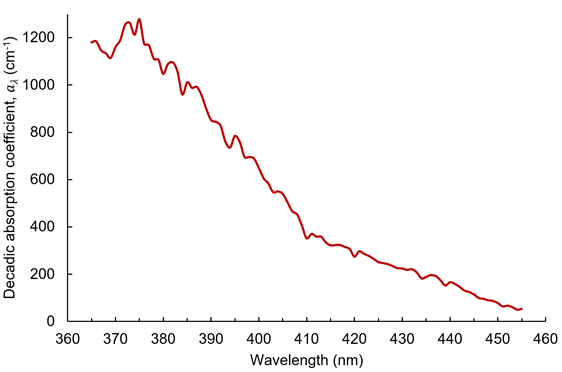
Figure 4. The average decadic absorption coefficient of the bulk liquid comprising Venus’s cloud aerosols: Model that changes how we see Venus’s cloud. From Spacek et al. (2026).
At that scale life cannot hide in a footnote. It should alter aerosol composition, sulfur chemistry, water cycling, particle physics, cloud nucleation, solar heating, sedimentation, lower-haze chemistry, and temporal variability. And if the proposed metabolism makes H2SO4 from SO2 while fixing carbon, life would literally help make the acid that makes the cloud.
That is the strongest version of the idea: the biosphere seeds the Venus cloud, helps form it, heats it, is carried by it, and may constitute a large fraction of its mass. It is also why the idea is scientifically useful. Every additional role creates another way to kill it.
The next steps should be hostile quantitative tests of the hypothesis: Astronomers should examine data presented in Spacek et al., (2026) – make sure the model is consistent with reality. If it is accurate, abiotic pathways to produce gigatons of low-efficiency UV-vis absorbers should be explored. Atmospheric chemists should force the reaction through a complete gas network. Cloud physicists should rebuild the aerosol with a large organic fraction. Dynamicists should test whether pigment heating really changes particle residence. Laboratory chemists should try to reproduce the carbon-sulfur coupling without biology. Mission scientists should ask which measurements discriminate the models.
The speculation that the clouds we observe is, in substantial part, the product of a planetary ecosystem, originates from a question “How dark is the liquid comprising in Venus clouds.” Since until recently nobody asked, we might have been missing massive biosphere. Instead, astronomers largely trusted the authorities who stated that “[t]here can be no free carbon, hydrocarbons, formaldehyde, or any other organic molecule present in more than trace amounts” (Dayhoff, Lippincott and Sagan, 1967).
Ward Cunningham is credited with this statement “The best way to get the right answer on the internet is not to ask a question; it’s to post the wrong answer.” I want to know what causes the coloration of the Venus’s cloud and if the liquid is really as dark as we presented in our lates paper. Therefore, this post serves as the possibly wrong answer presented to the community to ridicule, correct, and improve. Then we can pick up the usable pieces and submit whatever survives as a serious hypothesis article.
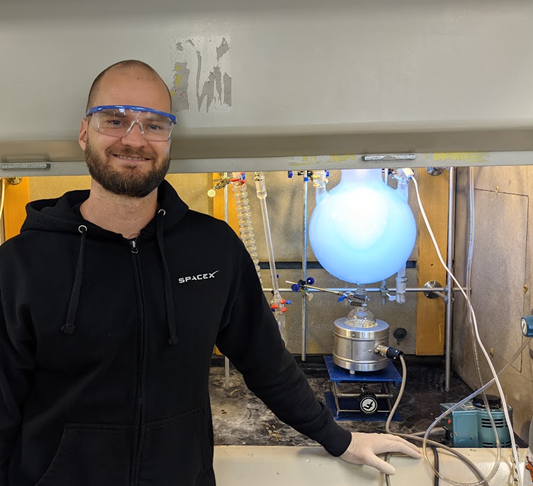
Figure 5. Spacek in 2021: Cloud of sulfuric acid vapor suspended in CO2/CO atmosphere under UV light as a Venus cloud analogy of Miller-Urey experiment. This experiment did not yield detectable reduced organic carbon products. I blame the failure on short-runs, not enough UV, and lack of detection sensitivity. All ultimately caused by my failure to secure sufficient funding.
NOTES and comments:
8/28/2026: Could the infrared signature of the massive biosphere hide in the clouds?
Martin Ferus from the Czech Academy of Sciences sent me a message suggesting that if Venus’s clouds contain a lot of organic material, we might be able to see it in the infrared.
For organics in the liquid phase:
First thing that came to my mind was a comparison of relative absorption between the UV maximum and IR vibration spectra of the potential organic pigment. For example, Chlorophyll a, as an example of a strong organic pigment, has a molar absorptivity at Soret maximum of about (10^5) M-1cm-1. A strong organic IR vibration such as C=O is typically only a few hundred M-1cm-1. Thus, at equal concentration, the visible maximum can be roughly 200–300 times stronger than an individual IR band. At ~12 g/L, a chlorophyll-like pigment would have (amax≈1,500) cm-1, but individual strong IR bands might give only (aIR≈10) cm-1. Given that our model showed that a < ~50 cm-1 is lost in noise due to the high scattering.
However…ChatGPT told me that scattering becomes less of a problem in the mid-IR. For Venus’s ~0.4-µm and ~1.3-µm-radius cloud particles, the Mie size parameter falls from ~7 and ~21 at 375 nm to only ~0.27 and ~0.8 at 10 µm. The small particles therefore scatter dramatically less at 8–13 µm, although the largest cloud particles remain Mie scatterers.
The bigger problem is the sulfuric acid itself. Concentrated H2SO4 has very strong absorption throughout the mid-IR; measured optical constants imply decadic absorption coefficients of hundreds to several thousand cm-1 over much of this region where our absorber should be ~20 cm-1. An organic component might therefore appear only as very small distortions of the liquid H2SO4 spectrum. Question back to Martin Ferus: can we see this expected difference? What’s the limit of detection for various IR signatures for our instruments?
For organics in the gas phase:
Gas-phase organics may not be present at detectable levels: Concentrated sulfuric acid irreversibly traps or reacts with many organic volatiles. The compounds most likely to escape, such as methane and other very reduced saturated hydrocarbons, are on Earth produced in reducing or anaerobic environments and are not necessarily the secondary metabolites one would expect from life operating in the oxidizing Venus cloud environment. Absence of abundant organic gases would not necessarily imply absence of abundant organic material in the droplets. The liquid phase may therefore be the better test.
Here is what AI thinks about what can be done to test the organic absorber with the IR observations: Ground-based observations can access roughly the 8–13 µm, as Earth atmosphere blocks the rest of the organics-relevant IR spectrum, and probe the thermal-emitting upper cloud near ~62 km. IRTF/TEXES can examine selected intervals at very high spectral resolution; broader 8–14 µm spectroscopy is possible with IRTF/MIRSI, although MIRSI is temporarily unavailable during 2026B upgrades. Existing VLT/VISIR observations may also be worth reanalyzing. Longer term, the 39-m ELT with METIS will provide 7.5–13.5 µm spectroscopy at much higher spatial resolution.
So yes: a large organic inventory could plausibly hide spectroscopically inside the sulfuric-acid clouds—but it should not simply be assumed to be invisible. A laboratory spectrum of realistic H2SO4 droplets with and without ~1–10% complex organic material, measured at Venus upper cloud temperatures, would tell us exactly what residual signatures to look for in existing Venus spectra.



Hi Jan,
Comments on Primordial Scoop part 1:
First of all:
Congrats, this is such an elegant idea.
Second of all:
I love the referral to the Dawkinsian “extended phenotype” :). It really is an extended phenotype.
Questions/Comments:
1) If there is so much biomass in the clouds of Venus, why aren’t the clouds of Venus green? If you were a Venusian autotroph (phototroph?) would you not be green? I do think so. Venusian cloud biosphere (in the middle and lower clouds) is not exposed to more UV radiation than Earth surface (Dartnell et al. 2021) so I would assume that you should expect “green biosphere” as the light conditions should be similar to Earth surface.
2) “A large organic mass fraction should also alter refractive index (…)”. Crucial: In which direction? Towards higher values or lower? Maybe we already saw it with PV 🙂
3) How quickly the biological carbon is lost from the clouds? There are vertical winds, which could act as an additional mechanism to bring back life particles or anything else back to the clouds, without thermally destroying them – vertical gusts of up to 4 m/s within the cloud layer (Imamura et al. 2026).
Additionally in (Seager et al. 2021), but also many others, calculated the residence times of particles, hard to say if these numbers are 100% correct, but they are probably minimal – i.e. the residence time can be higher than what was calculated there. Residence times of many years are quite possible (and that is passive, any living organism will evolve increased residence time!).
4) How to conserve Hs in biochemicals? There are two ways of conserving Hs in biological molecules in sulfuric acid on Venus that we can come up with:
i) You use F instead of H for substitution of all structural Hs where H can be functionally substituted. I call it structural Hs, i.e. H that does not have to participate in any H-specific reactivity can be substituted with F. There is HF in the clouds of Venus, and there is probably MUCH more F in the clouds than we think as HF is just an absolute minimum of F reservoir. According to (Zolotov 2004) the main reservoir of F on Venus is not HF it is various S-F compounds – produced by Venus’ volcanoes (the S-F’s are stable, especially if there is no water). Venera 14 did detect SF6 in quite a high abundance of 1 ppm (it is not an artifact or a contaminant, people did not really use SF6 back then for “space tech”).
ii) and this is crazier, a lot of organics in concentrated sulfuric acid just lose their Hs – create carbocations, or god knows what crazy other H-less systems – but are still stable, i.e. their overall carbon scaffolds are. We see this all the time with very efficient H/D exchange of C-H protons. Now, maybe this is another way to conserve the Hs? You just donate it to H2SO4 or elsewhere and have functional organics anyway in this solvent? How many Hs you can “conserve” this way is anybody’s guess, but it is possible.
5) Assuming that PH3 is real, and assuming that it is NOT a biological product but rather a non-biological production (Mráziková et al. 2024) of 2ppm of PH3 at 51 km (Mogul et al. 2021) how much PH3 helps with the H-problem? It might be a powerful reductant, that might also ease your water problem.
6) “there is not obviously too little reported oxygen for the massive-biosphere hypothesis” – Please… I would really phrase it differently 🙂 I had to pause to think what it means! It simply means that there is enough O2 and that the detected Venera 14 and PV GC O2 values agree with the “Spacek Venusian biosphere hypothesis”.
More on O2 – note that O2 was detected by GC and MS – it might be stored inside the droplets, not released to the atm. as a waste product as it is on Earth – if it is stored within aerosols in the mid-low clouds only (as the measurements would suggest) then the lack of it above the clouds is not a mystery – there is no significant O2 to diffuse up because it is stored in the aerosols – in a not very leaky way.
6) The lower haze (which is quite stagnant) might also be “spores” in waiting, not necessarily a “carbon graveyard”, as per (Seager et al. 2021).
7) Regarding this: “Many organics exposed to concentrated sulfuric acid evolve toward broad, tar-like absorption.” – if you cook it in 120C then yes, but these are not the temperatures of the habitable cloud region. The very bottom of the clouds is approx. 80C. I would not obsess too much about the “tar problem”. If life figures out the retention time (which it damn should after 4.5 Gyr in the clouds!*) then akin to plankton in an ocean you have different vertical populations that like to reside in different temperature/acid layers.
After a few years of research now, we can conclusively say that the chemical diversity of organics in concentrated sulfuric acid is not lower than in water (sugars, sure they die, but other things, absolutely not – just do not cook it to 120C!) and that the stability of organics in concentrated sulfuric acid is a norm rather than exception (even very complex ones).
*[PS. I do not believe that Venus ever had liquid water oceans, I do believe that it had a very stable cloud env. for billions of years, as more an more people tend to think nowadays (e.g. Constantineou et al. 2025) and as a result if there is life in the clouds of Venus it had to have a separate OOL, in the clouds, in concentrated sulfuric acid]
8) Why would Venusian life need phosphorus? I do not think it would. For Earth life yes, for Venusians not really.
9) Regarding this: “Most importantly, no spacecraft has directly detected the massive organic aerosol reservoir required by the strong version of this hypothesis.” – because none of the spacecraft had ANY MEANS to detect organics. There could be a “flying dragon” there and PV and Venera probes would miss it. NONE of the instruments had a chance of detecting organics even if there were tons of them. So I would not be so negative, as it reads as they failed. They did not.
10) Our work on IR in concentrated sulfuric acid shows it is a nightmare… because sulfuric acid really masks a lot of features of “common” organics. But maybe some boring IR survey of organics dissolved in concentrated sulfuric acid is warranted to really nail this problem.
Awesome work!
JJ
I thought you might find this story of interest.
Rocket issues delay 1st-ever private mission to Venus: ‘We are awaiting Neutron readiness’
https://www.space.com/astronomy/venus/rocket-issues-delay-1st-ever-private-mission-to-venus-we-are-awaiting-neutron-readiness
Unveiling Venus: A Slow-going Private Affair
https://www.leonarddavid.com/unveiling-venus-a-slow-going-private-affair/