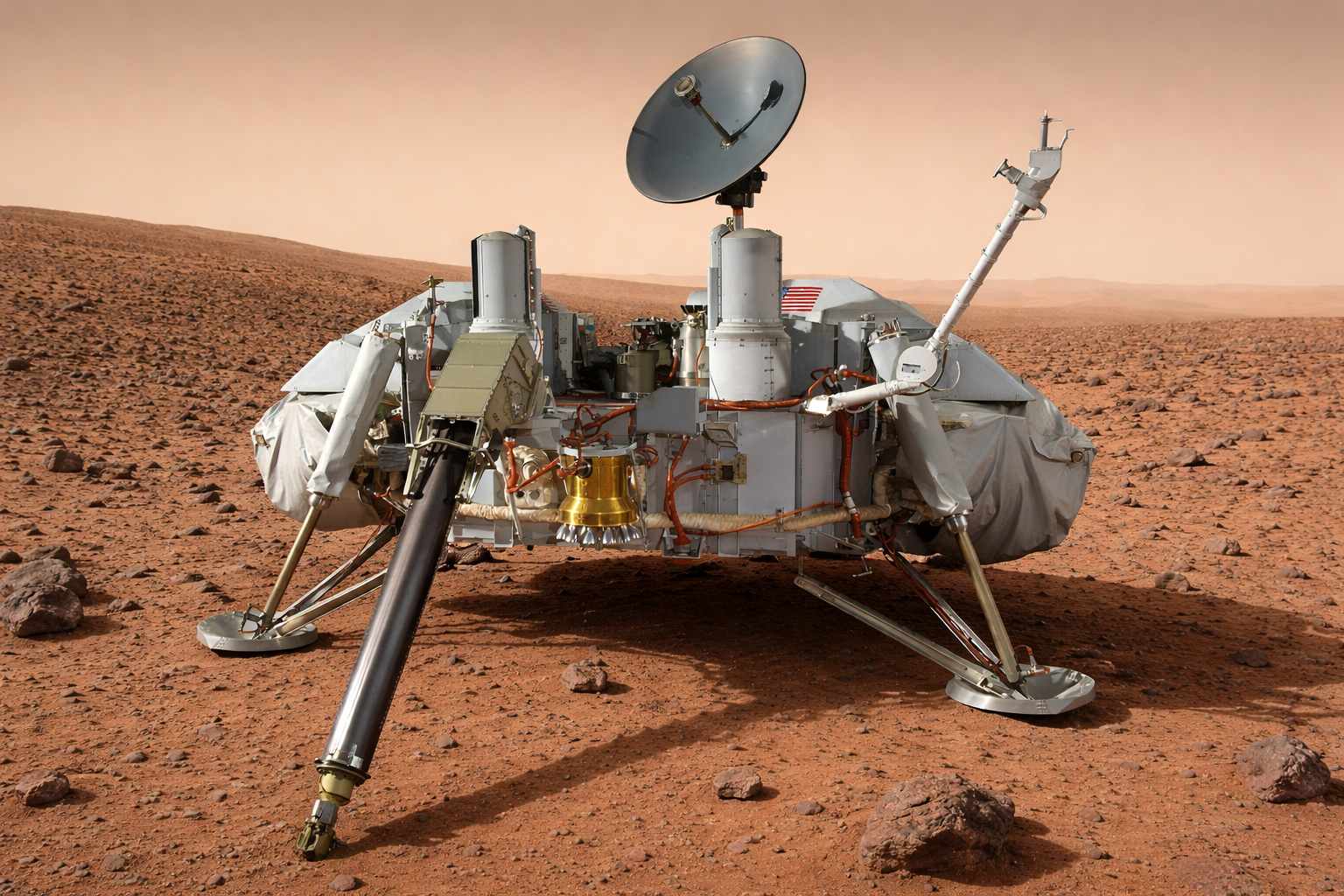
Most people interested in Solar System exploration know that in 1976, two craft in NASA’s Viking mission landed at two sites on Mars. Most also know that the Viking landers performed experiments that sought evidence for life living today (“extant life”) in Martian soils at those landing sites. However, surprisingly few people can say with accuracy what data the Viking experiments actually collected. Fewer understand how our interpretation of Viking results has changed in light of information gathered since.
Perhaps most worrisome, still fewer have freed themselves from an incorrect “community consensus” that began to be formulated in 1976, that “Viking failed to find signs of extant life on Mars“. This “consensus” has persisted long after 2010, when it was shown that it was based on mistakes made in the early interpretation of the Viking data (Navarro-Gonzalez et al., 2010). Indeed, most papers being submitted this year to a special edition of Astrobiology commemorating the half century since the landings still get it wrong.
In an effort to correct this, I have written a book entitled: Meet the Neighbors. Life on Mars and How to Find It. It will be released by Penguin Press in July on the 50th anniversary of the Viking landings (Benner, 2026, Meet the Neighbors. Life on Mars and How to Find It).
However, since “To Long Didn’t Read” is a theme in the modern world, I am posting here a series of short Single Scoops for those who are crushed for time, to bring you up to date. This, the first, summarizes the data from Viking directly relevant to extant life detection.
This summary will be followed by sets of Single Scoops, one set for each of the Viking experiments.
1. The first Scoop in each set will explain how and why the individuals who created each Viking experiment designed their experiments. This was the intention of the experiment.
2. The second will describe what experimental data were actually observed when the experiment was run on Mars, and how they were interpreted, immediately, and then in light of other data that led to the incorrect “community consensus” that has propagated for 50 years.
3. The third will discuss how we reinterpret those observations today in light of what we have learned since 1976 about the Martian environment, and from astrobiology studies here on Earth.
4. Jan Spacek and his team have developed a concept of a ride-share system that delivers to Mars thousands of penetrators in one launch. This democratizes Mars exploration by lowering the cost per experiment to a few tens of thousands of dollars (International Mars Prospector Ride Share, IMPRESS) that avoids the limitations of “community consensus”. The fourth Scoop in each set will describe experiments that might be done on such penetrators to help resolve the remaining Viking uncertainties, and Earth-based experiments to help design them.
5. The last Scoop in each set will comment on the sociology of this science, why the “community consensus” got things so wrong for so long. It will focus on what students in astrobiology might learn from the mistakes of their elders.
For now, here is what you need to know about the Viking experiments, with interpretations of Viking results presented in the terms of the experiments’ original design, without more.
• The Viking experiments that sought Martian photosynthesis found evidence for it. Martian soils fixed radioactive 14CO2 in amounts corresponding to ~1000 Earth-like cells per gram of soil. The amount of carbon fixation may be 100x larger depending on how much perchlorate was present in the soil, the ratio of products arising from the oxidation of organics by perchlorate and nitrate, and how much 14CO2 was absorbed unfixed in the soil as carbonates stable at 120 °C. This inferred Martian bio-load is comparable to bio-loads seen in resource limited environments here on Earth (Carrier et al. 2020). No reasonable mechanism has been proposed to explain the carbon fixation without biology. However, non-fixed 14CO2 absorbed on the soil as inorganic carbonates stable at 120 °C might offer a false positive for part of the signal. Forward contamination is a concern as well.
• The Viking experiments that sought Martian respiration saw it. Martian soils released radioactive 14CO2 from 14C-labeled “food” in amounts that were also consistent with~1000 cells per gram. Perchlorate cannot directly offer a non-biological explanation for these results. An alternative non-biological oxidant might explain these results, but so far, none of the oxidants proposed fit the Viking data in terms of rates. Forward contamination remains a concern.
• The Viking experiments seeking exchanges of gasses in and out of the Viking soils saw them. Soils harboring life were expected to exchange gasses agnostic of their metabolic survival strategy. That exchange was seen for CO2, as was an unexpectedly large amount of O2 released upon soil humidification. The unexpected result is compatible with both biologically stored O2 and abiologically stored O2. The “community consensus” interpretation, that these data show that the soils must contain a “highly reactive oxidant”, has little experimental support.
• The Viking gas chromatograph-mass spectrometer (GC-MS) detected large amounts of organic molecules in the Viking soils. These were detected indirectly, in the form of methyl chloride and other chlorinated organics that were created by their oxidation by perchlorate, also present in the Viking soils (Navarro-Gonzalez et al., 2010). This interpretation has been confirmed by the Curiosity rover (see Pavlov et al., 2025 and references therein). Nevertheless, Klaus Biemann, in a paper in Science in 1976 (Benner et al., 2025), incorrectly called methyl chloride a “terrestrial contaminant”. Then, in 1977, biologist Norm Horowitz incorrectly called methyl chloride a “cleaning solvent” (presumably confusing it with chlorinated ethylenes that are cleaning solvents; methyl chloride is a gas that boils at -24 °C). The “community consensus”, that Viking found no organics, was never corrected.
In what will likely be a year-long effort to correct the half century of mistakes surrounding Viking, we posted an e-letter last October on Science to correct Biemann’s 1976 paper (Benner et al., 2025). A peer-reviewed paper in Astrobiology last month takes the next steps (Benner et al., 2026).
Finally, two important papers from the Perseverance and Curiosity rover teams relevant to past Martian life are here: Hurowitz et al., 2025 and Pavlov et al., 2025.
References
Benner, S. A., Schulze-Makuch, D., Spacek, J., Abraham, C. A. (2025) The mistaken assignment in this paper of Martian methyl chloride as a “terrestrial contaminant” obstructed Mars exploration for a half century, continuing to today [eLetter]. Science https://www.science.org/doi/10.1126/science.194.4260.72#elettersSection
Benner, S. A., Schulze-Makuch, D., Spacek, J., Abraham, C. A. (2026) Viking Mars, now 50 years old, still needs a scientific analysis. Astrobiology doi:10.1177/15311074251404929
Carrier, B. L., Beaty, D. W., Meyer, M. A., Blank, J. G., Chou, L., Dassarma, S., des Marais, D. J., Eigenbrode, J. L., Grefenstette, N., Lanza, N. L., Schuerger, A. C., Schwendner, P., Smith, H. D., Stoker, C. R., Tarnas, J. D., Webster, K. D., Bakermans, C., Baxter, B. K., Bell, M. S., Benner, S. A., Bolivar Torres, H. H., Boston, P. J., Bruner, R., Clark, B. C., Dassarma, P., Engelhart, A. E., Gallegos, Z. E., Garvin, Z. K., Gasda, P. J., Green, J. H., Harris, R. L., Hoffman, M. E., Kieft, T., Koeppel, A. H. D., Lee, P. A., Li, X., Lynch, K. L., MacKelprang, R., Mahaffy, P. R., Matthies, L. H., Nellessen, M. A., Newsom, H. E., Northup, D. E., O’Connor, B. R. W., Perl, S. M., Quinn, R. C., Rowe, L. A., Sauterey, B., Schneegurt, M. A., Schulze-Makuch, D., Scuderi, L. A., Spilde, M. N., Stamenković, V., Torres Celis, J. A., Viola, D., Wade, B. D., Walker, C. J., Wiens, R. C., Williams, A. J., Williams, J. M., Xu, J. (2020) Mars Extant Life: What’s Next? Conference Report. Astrobiology 20, 785–814.
Chandler, D. (1977, February). Life on Mars. The Atlantic Monthly, 239(2), 18–24.
Hurowitz, J. A., Tice, M. M., Allwood, A. C., Cable, M. L., Hand, K. P., Murphy, A. E., … & Wolf, Z. U. (2025). Redox-driven mineral and organic associations in Jezero Crater, Mars. Nature, 645(8080), 332-340.
Navarro‐González, R., Vargas, E., de La Rosa, J., Raga, A. C., & McKay, C. P. (2010). Reanalysis of the Viking results suggests perchlorate and organics at midlatitudes on Mars. Journal of Geophysical Research: Planets, 115(E12).
Pavlov, A. A., Freissinet, C., Glavin, D. P., House, C. H., Stern, J. C., McAdam, A. C., … & Gomez, F. (2025). Does the Measured Abundance Suggest a Biological Origin for the Ancient Alkanes Preserved in a Martian Mudstone?. Astrobiology, 15311074261417879.
Spacek, J., Benner, S.A. (2022) Agnostic Life Finder (ALF) for large-scale screening of Martian life during in situ refueling. Astrobiology 22, 1255-1263. doi.org/10.1089/ast.2021.0070
Spacek, J. (2024)IMPRESS to Deliver Art and Science to Mars. Primordial Scoop, e20240920. https://doi.org/10.52400/PCFY7624
Posted with minor revisions by Jan Spacek 2/18/2026.