Autotrophy on Mars (4): What Next?

Autotrophy on Mars (4): What Next?

What should we do with a 50-year-old life-detection experiment whose signal was real, but whose interpretation remains tangled in false positives, false negatives, and missing follow-up work? This article lays out the unresolved weaknesses in Viking’s HHH carbon-fixation results, then turns the problem into a set of concrete astrobiology challenges—suggesting how Earth-based tests and a modern IMPRESS-style instrument could finally clarify whether Mars once gave us a genuine sign of autotrophic life.
Autotrophy on Mars (3): How Data Lost Out to the “Community Consensus”

Autotrophy on Mars (3): How Data Lost Out to the “Community Consensus”

Did Viking’s carbon-assimilation experiment actually detect evidence of Martian autotrophy—only to have that result buried beneath a later “community consensus” that declared Mars lifeless? This article revisits the Horowitz–Hobby–Hubbard data, argues that the life-positive signal was real and logically never refuted, and traces how GC-MS interpretations came to outweigh contradictory evidence in the story of Viking.
Autotrophy on Mars (2): Viking Detects Martian “Photosynthesis”

Autotrophy on Mars (2): Viking Detects Martian “Photosynthesis”

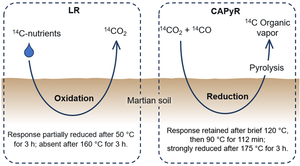
Viking’s carbon assimilation experiment was designed to detect whether Martian soil could fix labeled inorganic carbon (¹⁴CO₂/¹⁴CO) into “higher” organic matter, and it returned a small but statistically significant signal in the fraction interpreted as newly formed organics. However, the results were dominated by a much larger labeled CO₂/CO release that bypassed the organic trap (the “Peak 1” anomaly), raising the possibility of false positive results due to adsorption or carbonate chemistry.
Autotrophy on Mars (1): Seeking Martian Photosynthesis

Autotrophy on Mars (1): Seeking Martian Photosynthesis

Here I examine Viking’s carbon assimilation (a.k.a. “pyrolytic release”) experiments aimed to detect Martian autotrophy by following labeled carbon from atmospheric CO/CO₂ into soil organics, followed by the release of labeled volatile gases by pyrolysis. These experiments were prone to both false negatives (oxidants burning organics) and false positives (alkaline soils binding CO₂). And yet when taken in context of the current understanding, these results might be the most important in the series of the Viking biological experiments and are worth studying in detail.
Viking Experiments on Mars: Fixing a Half Century of Mistakes

Viking Experiments on Mars: Fixing a Half Century of Mistakes

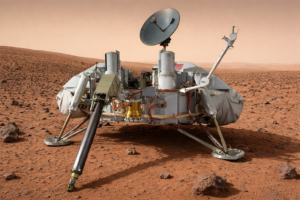
Half a century ago, Viking delivered evidence suggesting metabolically active life on Mars, but its legacy was derailed by a mistaken GC–MS interpretation that shaped Mars exploration for decades. This is the firsts article in a series that reexamines Viking’s experiments and results from primary data, shows how they were (mis)interpreted, and that suggests life-finding strategies.
Radiation on Mars is less likely to kill you than sitting on your couch

Radiation on Mars is less likely to kill you than sitting on your couch

We have all heard that radiation on the Martian surface is dangerous to humans and that it would limit the extent of life there, both indigenous and transplanted. However, what is rarely mentioned is how dangerous the radiation is exactly. I will attempt to quantify this danger. In short: If you choose to forgo exercise and have a poor diet, you have a higher chance of premature death due to cancer than if you lead an otherwise healthy life but are exposed to Mars-surface radiation levels.
Ribonucleic acid is formed by percolating ribonucleoside triphosphates through basalt glass

Ribonucleic acid is formed by percolating ribonucleoside triphosphates through basalt glass

This simple reaction is the last step in a modeled "discontinuous" process that moves from sulfite- and borate-stabilized carbohydrates, a post-impact atmosphere, and rock species delivered from basalt glass, all of the way to what might be the process forming what might have been the first genetic molecules on Earth ... and Mars.