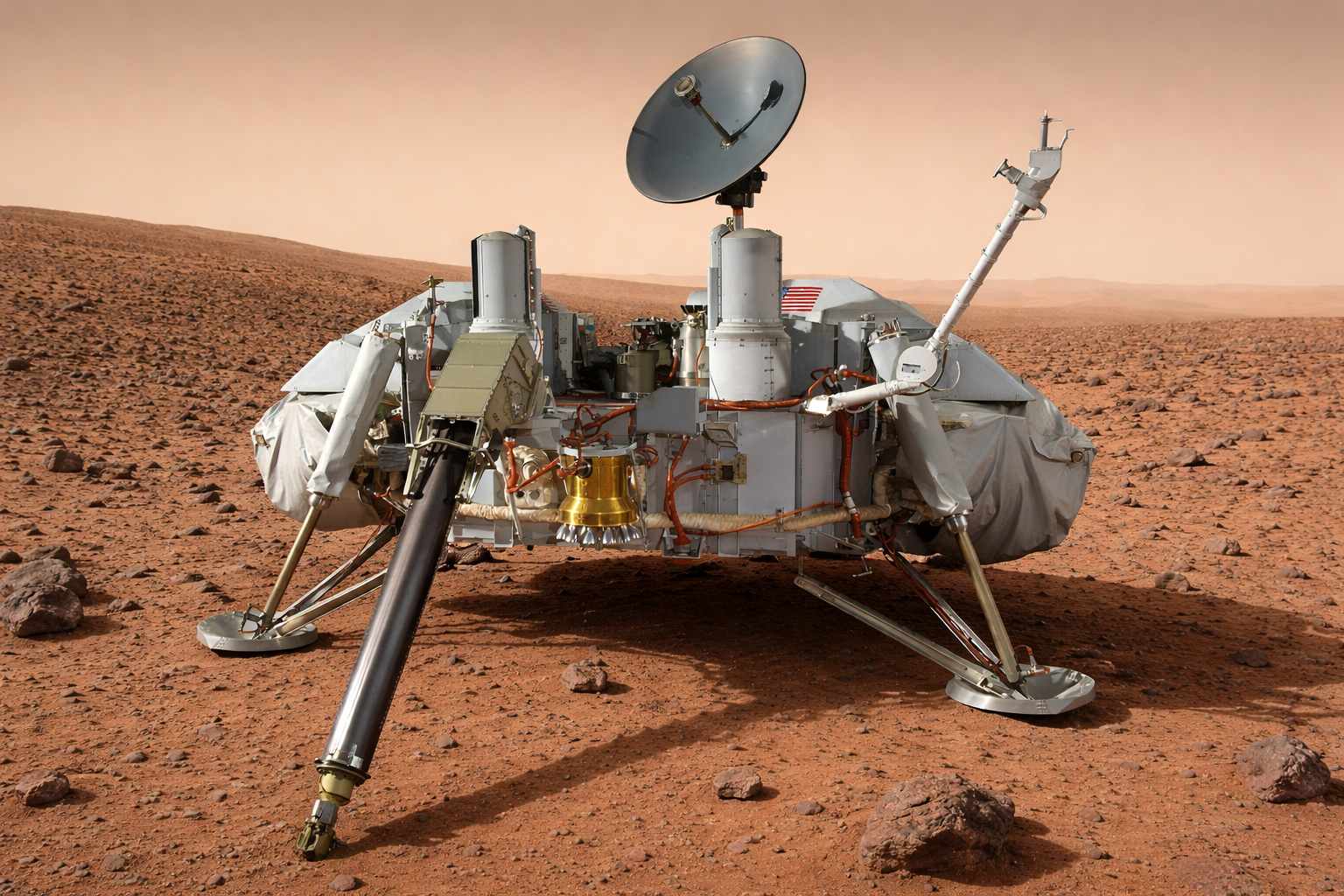
Autotrophy on Mars: How Data Lost Out to the “Community Consensus”
When we left the story last, the HHH experiment had returned statistically significant data (at three sigmas) showing that the Martian soils had fixed 14C-carbon from 14CO2 and/or 14CO to give 14C-labeled “higher organics”. The amount of radioactivity in this “Peak 2” corresponded to enough carbon for about 1000 Earth-like cells (Horowitz et al., 1977).
Under the terms of the experimental design, this met a “preponderance of evidence” standard for life on Mars. Martian autotrophy was more likely than not at the Viking sites. This conclusion remains largely undisturbed even today, as discussed in a following Scoop.
A possible false positive had been recognized and managed. The HHH experiment had brought along its own filtered light source. This mitigated the possibility that 14CO in the experiment might be fixed without biology by the strong ultraviolet light that comes naturally to the surface of Mars.
The HHH experiments had, however, seen an anomalously large amount of “Peak 1” radioactivity. This was radioactivity released from the soil as 14CO2 and/or 14CO at 635 °C, but not at 120 °C. The HHH team had attributed this to 14CO2 and/or 14CO absorbed to “soil grains and walls of the chamber” at low, but not high, temperatures. This Peak 1 radioactivity was not counted in the inventory of biologically fixed organics.
However, by 1976, the HHH team had evidently forgotten about the possibility that nitrate in the soil might have burned some of the biologically fixed organics in the Viking samples. The HHH team had seen exactly this in preparatory runs on Earth (Horowitz et al., 1972).
This combustion would move some of the radiolabel from Peak 2, which must be from organic fragments, into Peak 1, underestimating the inventory of biologically fixed organics. If all of Peak 1 was the product of this combustion by nitrate, then the HHH experiment saw the fixation of enough carbon to build ~100,000 Earth-type cells.
The HHH team did not consider the perchlorate oxidant in the Martian soils (Hecht et al., 2009). Perchlorate, like nitrate, would have also burned biologically fixed organics, delivering radioactivity to Peak 1 that also should be calculated to be part of the biologically fixed organic carbon inventory. In the following Scoop, we will reinterpret the Viking data in a way that considers perchlorate. But we are getting ahead of ourselves.
The “community consensus” has denied this conclusion for 50 years
It is always dangerous to speak of a “community consensus”, since this community does not have an individual authorized to define it. However, multiple documents in this field say that they have tried to achieve it (Meadows et al., 2022). We will use these documents, as well as textbooks, Wikipedia pages, and other sources that adumbrate the views of people who advise NASA about how to direct its scarce resources in space exploration.
Take one textbook, Astrobiology, published by Jonathan Lunine in 2005. In its section on the Viking results, it taught students that in the HHH experiment, “no detection of [fixed] radioactive carbon was made, suggesting that no photosynthesis actually occurred during the experiment.” This is, of course, the opposite of the facts as reported in 1976 (Klein et al., 1976)
Further, when queried on 20 September 2025, the Wikipedia page devoted to Norman Horowitz annotates his carbon-fixation experiment with the following remark: ‘Horowitz’s . . . experiments . . . provided the first indication that there is no current life on the surface of Mars.’ [italics added].
How did “yes life” end up being “no life”?
In summary, after the Viking experiments had ended, the “community” came to the “consensus” that life in the Viking soils was impossible because the soils contained an oxidant so powerful that it burns in minutes any organic molecules that came in contact it. Including all of the organics that were required for organic life.
The key observation behind this “community consensus” was a purported failure of a set of gas chromatography-mass spectrometry (GC-MS) experiments to find organic molecules in Martian soil samples. These experiments were run by Klaus Biemann, a mass spectroscopist at MIT (Biemann et al., 1977). Gerald Soffen, the Viking Chief Scientist, is quoted as saying from this interpretation of the GC-MS results: “That’s the ballgame. No organics, no life” (David L., 2023).
From then on, any data that were thought to indicate extant life in the Martian soils must have a non-biological explanation. After all, life was impossible in the Martian soils. Further, anyone who persisted in arguing against the “community consensus” must be wrong or, as Gil Levin reports, “to have disgraced science” (Ercolano, 2020).
As we shall see in later Scoops, no logical thread connects the GC-MS results to the “community consensus”. Further, at the time, it was clear that the GC-MS experiment had detected organic molecules. These included Freons (which had been seen in the flight out to Mars, and thus were almost certainly terrestrial contaminants), methyl chloride, and methylene dichloride. The last two had not been seen in the flight to Mars, and thus were (originally) seen by Biemann to be “possibly indigenous” to Mars (Biemann et al., 1977).
However, as we shall see, once the “community consensus” had been established, the data that contradicted it and their interpretations were changed to match the consensus. Thus, “yes data” evolved to become “no data”, and not always with logical precision.
Norm Horowitz documented that change in 1977
The story of how “yes” became “no” is perhaps best told by Norm Horowitz himself, in a 1977 piece that he wrote for Scientific American.
After reviewing the images taken at the Viking site, Horowitz began his analysis of Mars life detection experiments by discussing the GC-MS experiments, which sought vapors of organic fragments coming from samples of Martian soils that had been heated in stages to 500 °C. Much like the HHH experiment itself, but without the 14C radioactive label.
Here is what Horowitz wrote, with my additions in square brackets to add clarity:
“The only organic compounds detected [by the GC-MS] were traces of cleaning solvents known to have been present in the apparatus. The heated [soil] samples gave off carbon dioxide and a small amount of water vapor; nothing else was found. This result is surprising and weighs heavily against the existence of biological processes on Mars.”
And why? Horowitz continued:
“Even if there is no life on Mars, … the fall of meteorites onto the Martian surface would have brought enough organic matter to the planet to have been detected [by the GC-MS]. The absence of organic matter at the parts-per-billion level, however, suggests that on Mars organic compounds are actively destroyed, probably by the strong ultraviolet radiation from the sun.”
Some of Horowitz’s facts are wrong. Methyl chloride is not “a cleaning solvent”; it is a gas that freezes at -24 °C. It was not originally reported as a “terrestrial contaminant” although, as we shall see in a later Scoop, it came to be reported as such by Biemann, who also revised his data to conform to the “community consensus”.
Separately, heating the soil did indeed release carbon dioxide and water at 500 °C. But these could have been products of nitrate oxidation of organics in the soil, as the HHH team had itself shown in Atacama Desert soils on Earth.
Further, Horowitz could have done (but evidently did not do) a back-of-the-envelope calculation that (i) estimated the amounts of meteoritic organics that fall to Mars, and (ii) the rate at which they must be oxidized for them to drop below the limits of detection of the GC-MS. The calculation depends on how deeply the organics are gardened into the soil and other semi-unknowns. But even in the limiting cases, very slow oxidation would drop the level of meteoritic organics to below the detection limit of the GC-MS. And by “slow”, I mean half-lives on the order of tens of thousands of years.
Thus, any failure by the GC-MS to see meteoritic organics does not drive the “consensus” conclusion that the Viking soils contained an oxidant so powerful that it burns in minutes organic molecules that it contacts, and thus precludes near-surface life. Papyrus from the Egyptian Middle Kingdom is also oxidized by O2 over thousands of years, but this does not preclude near-surface Terran life.
But what was Horowitz to do with the “life-yes” data from the HHH experiments, which contradicted the “community consensus”? Here is what he writes:
“Nevertheless, it appears that the findings of the [HHH] pyrolytic-release experiment must also be interpreted nonbiologically. The reason is that the reaction detected was less sensitive to heat than one would expect of a biological process. In two of the nine pyrolytic-release experiments performed on Mars the soil sample was heated before the radioactive gases were injected and the incubation was begun. In one case the sample was held at 175 degrees C for three hours and in the other it was held at 90 degrees for nearly two hours. The effect of the higher temperature was to reduce the reaction by almost 90 percent but not to abolish it. The effect of the lower temperature was nil. When it is recalled that the temperature at the surface of Mars at the two landing sites does not rise above zero degrees C, at any time, and that the temperature below the surface is even lower, it becomes difficult to reconcile the results with a biological source. Any organisms living in the Martian soil should have been killed by those temperatures.”
Even the casual reader recognizes problems with this “argument”, even on its own terms. If the signal at low temperatures is “three sigmas” above background, then reducing it by 90% must certainly have lowered the signal that is “not abolished” to insignificance. Indeed, as we shall see in the following Scoop, one key issue in the HHH experiment is that its signal is not particularly strong, even when it is not lowered.
But who is to say what temperatures would kill organisms living in Martian soils? Unavailable to Horowitz at the time, but available to us now, are studies that show that many microbes return to viable states at low temperatures even after heating (Raghavendra et al., 2026).
If read from the perspective of textual criticism, Horowitz appears in his Scientific American piece to be writing not to adjudicate the meaning of a set of data from Mars, but rather in search of a way to move these data, which prima facie contradict a “community consensus”, into conformity with that “consensus”. Horowitz went on:
“One way to decide whether or not a process is biological is to test its sensitivity to heat. Living structures are highly organized and fragile, and they are destroyed by temperatures that leave many chemical reactions unaffected. A process that is insensitive to heat is thus likely to be a nonliving chemical reaction, but a process that is sensitive to it could be either living or nonliving.”
Again, the casual reader not committed to the “community consensus” sees the problem. The HHH data are sensitive to heat; the purported 14C-fixation stops if samples are pre-heated at 175 °C, at least to a level that is statistically insignificant. And, as we shall see in the next Scoop, the best chemistry presently available to deliver a false positive in the HHH chemistry is not stopped at 175 °C.
Norm Horowitz understood that his new view contains its own contradictions
Now, the alert reader might also see the bigger contradiction between the outcome of the HHH experiments and the “community consensus” that holds that Martian soils contain a powerful oxidant that destroys organic molecules in minutes or hours at low temperature. If the soil contained an oxidant rapid enough to do this, why did it not also oxidize the organics fixed in the Horowitz–Hobby–Hubbard carbon-assimilation experiment? Those organics accumulated over five days.
As it turns out, Horowitz himself was such an alert reader. Again in his 1977 Scientific American piece, here is what Horowitz was thinking:
“[I]t was surprising that in such a strongly oxidizing environment even a small amount of organic material could be fixed in the soil. It is not easy to point to a nonbiological explanation for this result.”
Indeed, it is not easy. But the community had concluded that life was not possible in the “strongly oxidizing environment” that was the Martian soil. And so there must be a “nonbiological explanation for this result”, even if we cannot point to one.
Having recognized the problem and its contradiction of the narrative, what does Horowitz do? Returning to Scientific American, Horowitz writes:
“Investigations into the problem are now under way in terrestrial laboratories with synthetic Martian soils formulated on the basis of the data from the inorganic analyses carried out by the Viking landers. A solution to the puzzle will probably also explain why the organic-analysis experiment detected no organic material in the Martian surface.Until the mystery of the results from the [HHH] experiment is solved, a biological explanation will continue to be a remote possibility.”
We teach students to observe editorial words in the literature, as they indicate what the author is thinking. Horowitz could have left out the word ‘remote’, and note simply that until the puzzle is solved, “a biological explanation will continue to be a possibility”. So why did he include the word “remote”?
We cannot read his mind across 50 years, but we can guess. Had he left out the word in a Scientific American article, which is read by the lay public, a reader might have seen a door left open for life-positive interpretations of the Viking results. Which was not the “community consensus”. This message indicates that the door is open only by a small crack. And from there, textbooks are easily written that say that the door is not open at all.
I will discuss in the next Scoop “investigations into the problem [that were then] under way” to resolve this problem. As it turns out, they did not. This is why a biological explanation for the HHH data “continues to be a possibility”.
For the students, another lesson: Never base your conclusions on the outcome of experiments that have not yet been run.
I will also suggest some direct experiments that might be done here on Earth to clarify these teachings, especially with respect resolving possible false positive and false negative problems when analyzing the HHH data. I have now for many years tried to get NASA fund such experiments. The peer reviewers, drawn from the community, have never endorsed this.
But I have no particular need to do these experiments myself. I simply want to know whether or not life exists today on the Martian near surface. So feel free to steal the ideas and do the experiments yourself.
References
Biemann, K., Oro, J. I. I. I. P. T., Toulmin III, P., Orgel, L. E., Nier, A. O., Anderson, D. M., … & Lafleur, A. L. (1977). The search for organic substances and inorganic volatile compounds in the surface of Mars. Journal of Geophysical Research, 82(28), 4641-4658.
David L. (2023) Mars life reveal? Evidence of diverse organic material on the red planet. Inside Outer Space. https://www.leonarddavid.com/mars-life-reveal-evidence-of-diverse-organic-material-on-the-red-planet/
Hecht MH, Kounaves SP, Quinn RC, et al. Detection of perchlorate and the soluble chemistry of martian soil at the Phoenix lander site. Science 2009; 325(5936):64-67; doi: 10.1126/
science.1172466
Horowitz, N. H., Hobby, G. L., & Hubbard, J. S. (1977). Viking on Mars: the carbon assimilation experiments. Journal of Geophysical Research, 82(28), 4659-4662
Horowitz, N. H. 1977. “The Search for Life on Mars.” Scientific American 237 (5): 52–61. https://doi.org/10.1038/scientificamerican1177-52.
Klein, H. P., N. H. Horowitz, G. V. Levin, et al. 1976. “The Viking Biological Investigation: Preliminary Results.” Science 194 (4260): 99–105. https://doi.org/10.1126/science.194.4260.99.
Lunine, Jonathan I. 2005. Astrobiology: A Multidisciplinary Approach. New York: Pearson.
Meadows, Victoria, Heather Graham, Veronica Abrahamsson, Z. Adam, Elena Amador‑French, Giada Arney, et al. 2022. “Community Report from the Biosignatures Standards of Evidence Workshop.” arXiv Preprint arXiv:2210.14293. https://doi.org/10.48550/arXiv.2210.14293
Posted with minor revisions by Jan Spacek 3/11/2026.
Spacek’s notes:
I sent Steven the Raghavendra et al., 2026 article because they show DNA production in Mojave Mars Simulant 2 (a fine-grade basaltic soil modified with 2-4 wt% calcium sulfate and oxides (Fe₂O₃, SiO₂, MgO, CaO) down to water activity 0.34 (!). The humidity was supplied through air. However if anyone want to dig deeper into this, they show in Fig. 4 no growth in non-spiked control at water activity 0.8 for 15 days, and yet essentially the same samples (no additional spiking) showed growth at water activity 0.75 – 0.34 (at aw = 0.75, after 15 days they had 1 ng of extracted DNA – according to fig. 5). Either I don’t understand the setup or there is something fishy. In any case survival of cells of dry heat up to at least 200 °C is well documented in different publications (Schubert, 2011 ; Dean, 2022). I have no doubt that Martians, if they are use to being boiled when temperatures reaches ~1 °C, can survive prolonged heating at ~150 °C as well.