Autotrophy on Mars (3): Misinterpreting the Viking Photosynthesis Experiment

Autotrophy on Mars (3): Misinterpreting the Viking Photosynthesis Experiment

Viking’s carbon fixation experiment looked for conversion of ¹⁴CO₂/¹⁴CO into organics, but its two-signal (“Peak 1” vs “Peak 2”) readout is ambiguous because inorganic carbonate/bicarbonate retention can mimic fixation and oxidants can convert labeled organics back into ¹⁴CO₂ during heating. The discovery of perchlorate strengthens an alternative interpretation in which Peak 1 could include combustion-derived ¹⁴CO₂ from fixed organics—meaning Viking may have measured substantially more carbon fixation than the original interpretation suggested.

Autotrophy on Mars (2): Viking Detects Martian “Photosynthesis”

Autotrophy on Mars (2): Viking Detects Martian “Photosynthesis”

Viking’s carbon assimilation experiment was designed to detect whether Martian soil could fix labeled inorganic carbon (¹⁴CO₂/¹⁴CO) into “higher” organic matter, and it returned a small but statistically significant signal in the fraction interpreted as newly formed organics. However, the results were dominated by a much larger labeled CO₂/CO release that bypassed the organic trap (the “Peak 1” anomaly), raising the possibility of false positive results due to adsorption or carbonate chemistry.
Autotrophy on Mars (1): Tests to Detect Martian Photosynthesis

Autotrophy on Mars (1): Tests to Detect Martian Photosynthesis

Here I examine Viking’s carbon assimilation (a.k.a. “pyrolytic release”) experiments aimed to detect Martian autotrophy by following labeled carbon from atmospheric CO/CO₂ into soil organics, followed by the release of labeled volatile gases by pyrolysis. These experiments were prone to both false negatives (oxidants burning organics) and false positives (alkaline soils binding CO₂). And yet when taken in context of the current understanding, these results might be the most important in the series of the Viking biological experiments and are worth studying in detail.
The Viking Experiments on Mars: An Overview

The Viking Experiments on Mars: An Overview

Half a century ago, Viking delivered evidence suggesting metabolically active life on Mars, but its legacy was derailed by a mistaken GC–MS interpretation that shaped Mars exploration for decades. This is the firsts article in a series that reexamines Viking’s experiments and results from primary data, shows how they were (mis)interpreted, and that suggests life-finding strategies.
The BARSOOM Model for Life on Mars

The BARSOOM Model for Life on Mars

Many different metabolic strategies might let life survive on Mars where Viking landed. One in particular explains all of the observations made by Viking. In addition, it is consistent with chemical principles, and "clever" natural selection likely evolved these Bacterial Autotrophs Respiring with Stored Oxygen in Overnight Metabolism as fit solutions to the challenges of living on the Martian surface.
Why does the NASA Culture Still Get Viking 1976 Wrong?

Why does the NASA Culture Still Get Viking 1976 Wrong?

Because one item of data from the 1976 Viking mission to Mars was misinterpreted, the NASA "consensus" has for a half century held that no life exists today on the surface of Mars. As is frequently seen in science, facts and logic have failed to dislodge this cultural belief. If we are ever to meet our neighbors, we must take matters into our own hands.
Science, Hype, and Prebiotic Chemistry

Science, Hype, and Prebiotic Chemistry

Commenting on our report that basalt glass catalyzes formation of polyribonucleic acid, Jack Szostak found it "very frustrating that the authors have made an interesting initial findings but then decided to go with the hype rather than the science". This offers an opportunity to discuss classical chemical structure proof, and the timing of scientific publications.
Ribonucleic acid is formed by percolating ribonucleoside triphosphates through basalt glass

Ribonucleic acid is formed by percolating ribonucleoside triphosphates through basalt glass

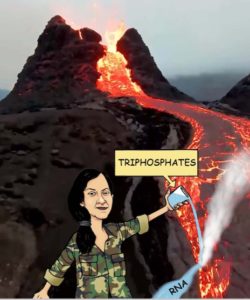
This simple reaction is the last step in a modeled "discontinuous" process that moves from sulfite- and borate-stabilized carbohydrates, a post-impact atmosphere, and rock species delivered from basalt glass, all of the way to what might be the process forming what might have been the first genetic molecules on Earth ... and Mars.