Cite as: Spacek, J. (2026) “Martian water management with biofilm slimes, a speculation.” Primordial Scoop, e20260109.
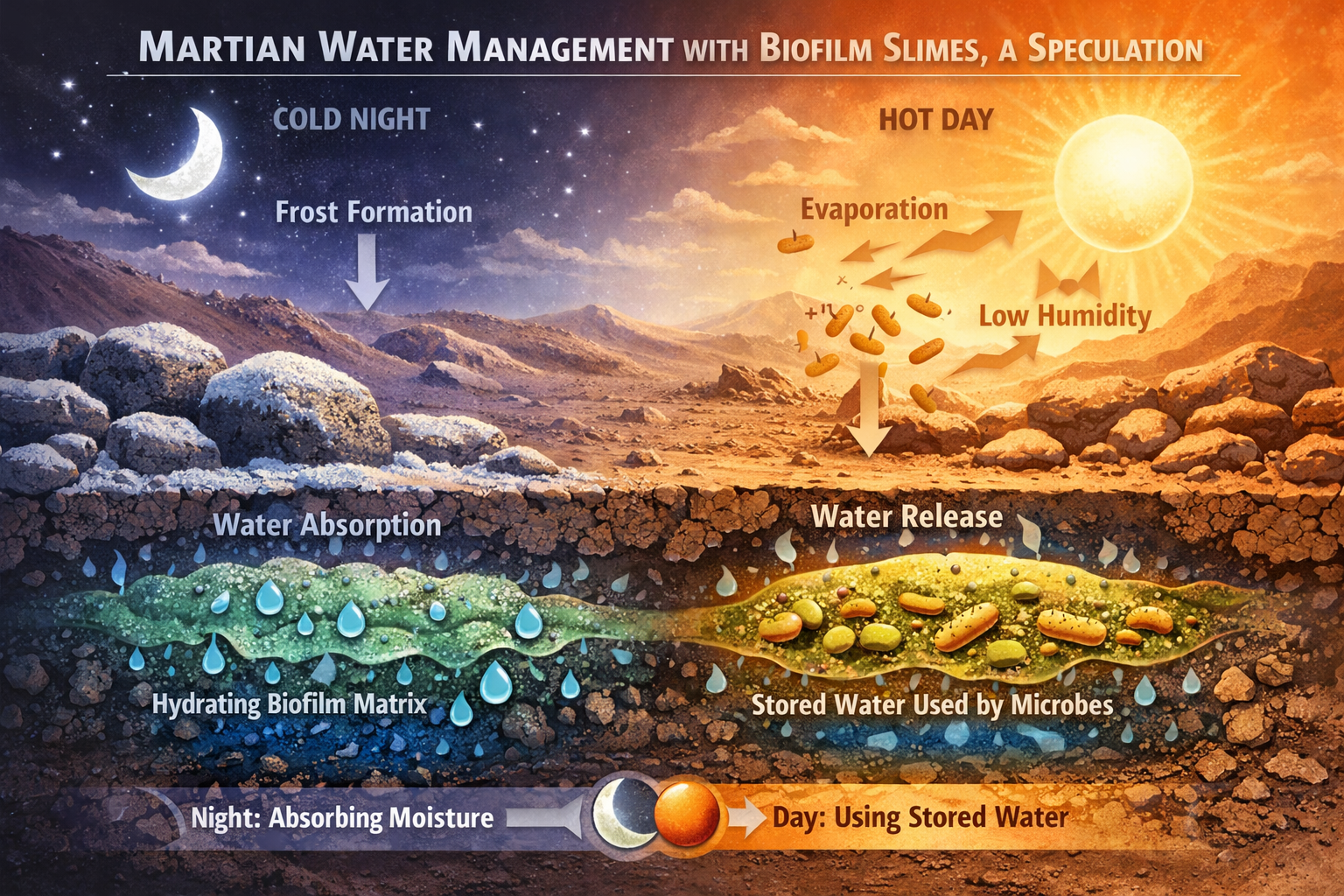
Martian life is exposed to many stressors at once, but temperature and water availability dominate because they jointly decide whether chemistry can run in a liquid solvent. Warm periods exist, yet they coincide with brutal daytime drying. I argue that a plausible loophole is not only “finding” deliquescent niches, but extending them: microbes could store night moisture inside extracellular matrix (biofilm) and use that stored water during the warm daytime window, enabling faster metabolism.
Life finds a way to survive in environments that we until recently perceived as “too hostile.” We now know that organisms managed to evolve to grow at temperatures that denature most proteins. They evolved to tolerate strong acids, and adapted to thrive in strong radiation. The speculations about life ability to survive on Mars usually do not account for the fact that life on Mars could have evolved abilities that exceed ones seen on Earth.
Mars is not one extreme. It is many. Cold. Dry. Irradiated. Low pressure. All can be survived, as long as there are conditions to sustain metabolism, and for that we need liquid solvent. If you cannot keep a liquid solvent at least transiently, biology turns to geology.
At very low temperatures, even if a cell avoids turning into a glassy, inert object, metabolism becomes slow enough to be almost pointless on human timescales. Fortunately, Mars is not super cold all the times. Daytime temperatures in some regions and seasons can exceed 0 °C. So, the obvious strategy appears: hibernate when cold, metabolize when it gets warmer seasonally or diurnally.
To illustrate, let’s consider Hellas Planitia, and within it Badwater Crater, the lowest point on Mars (≈ −8.2 km). Hellas contains the topographically lowest parts of Mars and therefore reaches the highest atmospheric pressures on the planet—up to ~14 mbar. It is also relatively “mild” by Martian standards: Voelker et al. (2017) summarize seasonal air temperatures between -120°C and 0 °C, with sunlit surface temperatures as high as 33 °C. In other words, in the Hellas basin, and Badwater crater by extension provides temperatures for fast metabolism and pressures above the triple-point of fresh water.
And yet, Hellas also illustrates the trap: when it is warm enough for biochemistry to run fast, it gets extremely dry. Voelker et al. explicitly note that Hellas’ high pressure and relatively mild temperatures are associated with desiccated air and soil (in their context, explaining scarcity of certain ice/water landforms). That is the mismatch: the summer nights in the Badwater Crater cold trap often exceed 100% relative humidity, leading to fogs, frosting, and vapor deposition in the ground. But as soon as the temperature rise after the sunrise the atmosphere attempts to freeze-dry the soil, preventing the existence of liquid water.
Mars’ near-surface water vapor condensation is well documented phenomenon across the Mars, not just in Hellas Basin. We have first-hand observation from the landers. Both Viking landers witnessed morning fog and frost, Phoenix lender noted water frost at night, and even Curiosity, and Opportunity documented frosting events even though they landed near the equator.
As part of this speculation, I’m highlighting the lowest spot on Mars, as it serves as a cold trap, depositing more moisture than the surrounding land, and the higher pressure makes the freeze-drying process after sunrise less efficient, arguably making the lowest spot on Mars also one of the more habitable places. Still, moisture preservation during the day time, even in this “fertile” spot would be the key to the survival.
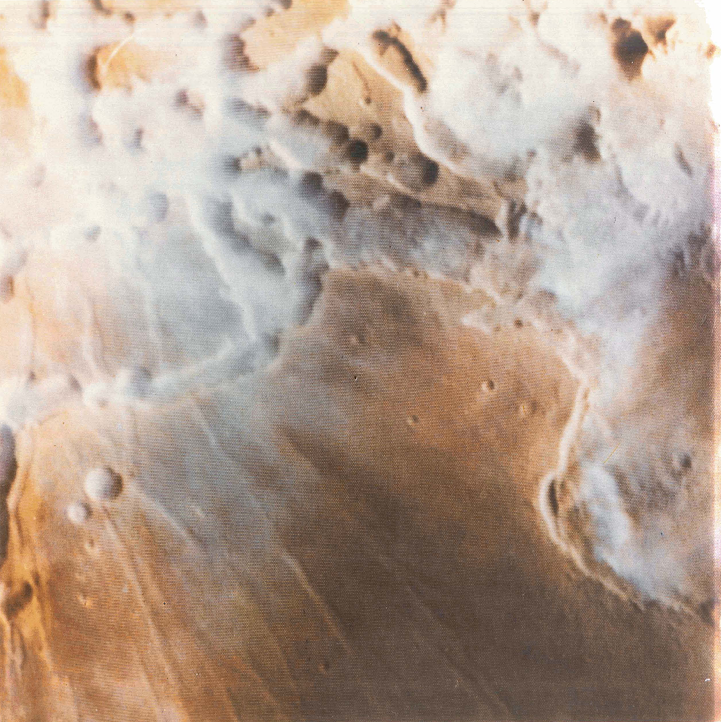
Figure 12. Foggy Morning in a Martian Valley. White patches of early-morning fog and mist fill a rugged network of Martian canyons and spill out onto the surrounding high, rust-colored plateau. The clouds are probably formed by water vapor that has frozen out of the air during the previous Martian night. In the sunlight, the water vaporizes again, becoming briefly visible as mist before being absorbed into the dry atmosphere. This part of Mars, called Labyrinthus Noctis (The Labyrinth of the Night) was photographed at dawn by the Viking I Orbiter; the view covers an area about 100 kilometers (62 miles) on a side. The color picture was made by superimposing three separate black-and- white images taken through color filters. Image credit Bevan M. French (1977) Mars: The Viking Discoveries
One way is purely physical: pores and salts. Small spaces change evaporation rate, as the diffusion of vapor through pore networks is slow. On top of that hygroscopic salts can deliquesce and create thin brines exactly where a microbe might hide. This is the “wet pores” argument: life does not need Mars to be wet. It needs a protected geological microhabitat that stays wet longer than the bulk atmosphere would suggest (out of equilibrium with atmosphere). That’s why deliquescent salts are repeatedly proposed as strategic targets for extant-life search discussions.
But Martian life does not have to accept whatever niche the Mars geology can provide. Life builds environments. Microorganisms on Earth are known to excrete extracellular polymers and make biofilms that absorb and store water and slow down vapor diffusion.
Jänchen et al. (2016) provided a Mars-relevant example using Nostoc commune biofilms with halite, showing that deliquescence can provide liquid water for limited periods and that the biofilm itself is hygroscopic and tends to store water at lower humidity values. They show a biofilm can hold water when the environment “should” have already dried it. The Nostoc commune is no longer merely finding a niche; it is extending it, here on our wet Earth.
Now imagine the selection pressure on Mars, as it slowly dried. If the goal is to “retain more water for longer into the warm daytime window,” I would expect evolution to push extracellular polymers in a predictable direction: more strongly water-binding chemistry (more ionic and polar functional groups per unit biomass), stronger hysteresis (a matrix that hydrates at night but very slowly dehydrates during the day), and architecture that behaves like a vapor brake: an outer skin that slows water loss protecting an inner reservoir that stays wet and feeds cells slowly. The goal is not puddles. The goal is thin (bio)films in pores that persist for a few extra hours when temperatures allow re-start of biochemical machinery.
We can even see, from materials science, that “Nostoc-like hygroscopy” is not an obvious ceiling. Wu et al. (2021) showed a synthetic sorbent PAETA–Ac (a polycationic hydrogel paired with acetate): it reportedly achieves water uptake of ~0.31 g/g at 30% RH and ~0.87 g/g at 80% RH, highlighted as exceptionally high for a polymer sorbent in “pure form” without inorganic salt additives. If engineers can build a hydrogel that behaves like that, evolution can in principle explore similar directions with extracellular matrices: denser charge, stronger hydration shells, more hysteresis, and better “skin + reservoir” architectures, all optimized for the moisture retention on Mars.
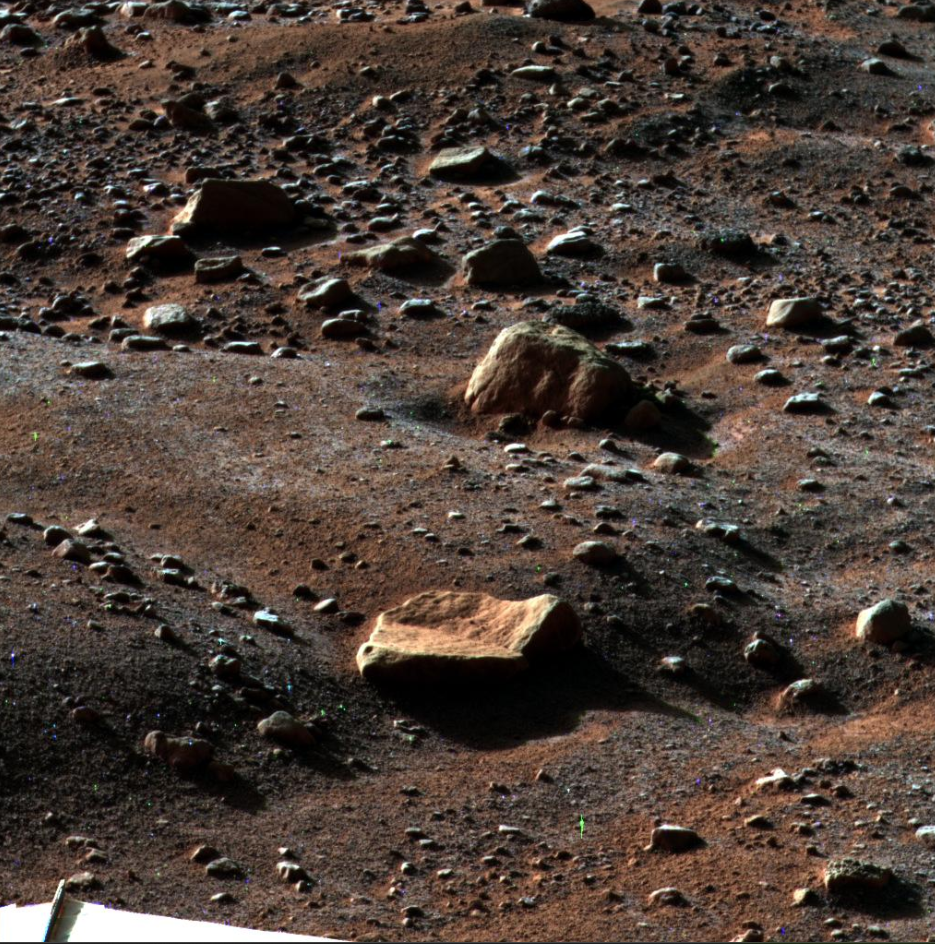
Morning Frost on Martian Surface. A thin layer of water frost is visible on the ground around NASA’s Phoenix Mars Lander in this image taken by the Surface Stereo Imager at 6 a.m. on Sol 79 (August 14, 2008), the 79th Martian day after landing. The frost begins to disappear shortly after 6 a.m. as the sun rises on the Phoenix landing site. Image from NASA Photo Journal.
If life ever existed on Mars, I believe that it now uses efficient extracellular matrices to solve the Mars’ scheduling problem. Cells accumulate water in biofilms at night during condensation or frosting events when the near-surface air reaches saturation with respect to ice or brines form in pores. They use that stored water during the day to run their metabolism, repair damage, and replicate while the temperature permits higher chemical turnover. The rest of the time they hibernate (this is in conflict with Steven’s BARSOOM. At night Martians sleep. The temperatures universally on Mars are too low to allow metabolism at a meaningful rate, with or without stored oxygen.).
The Martian MWMWBS (Martian Water Management With Biofilm Slimes) is an underexplored idea in the literature (and much less catchy acronym than BARSOOM, we shall work on it in the future). It predicts measurable hydration hysteresis and prolonged micro-wetness in polymer-rich microdomains compared with sterile controls under Martian diurnal cycles. If you can reproduce the effect in a Mars simulation chamber, you have something more than a story. If you can detect it in situ (with a machine that can extract polycations or polyanions), you’ve found life on Mars. (Alternative is a machine that looks for slime, but we are not building that one).
The question is simple: If extant life exists near the Martian surface, should we expect it is merely hiding in perfect deliquescent niches, waiting for salts to do the work? Or is it doing what life usually does here on Earth and expands beyond what’s allowed, and producing extracellular matrix, that perhaps perform a little better slimes on Earth, making its own microclimate to catch water during night, which it uses when sun warms it up?
Note: After posting this Steven Benner send me 1978 NASA’s “Rock Pushing and Sampling under Rocks on Mars” paper By: H. J. Moore, S. Liebes Jr., D.S. Crouch, and L.V. Clark https://doi.org/10.3133/pp1081. It shows that Viking landers found wet spots under rocks (higher moisture than in surrounding soil). Too bad that they did not check for slimes there.