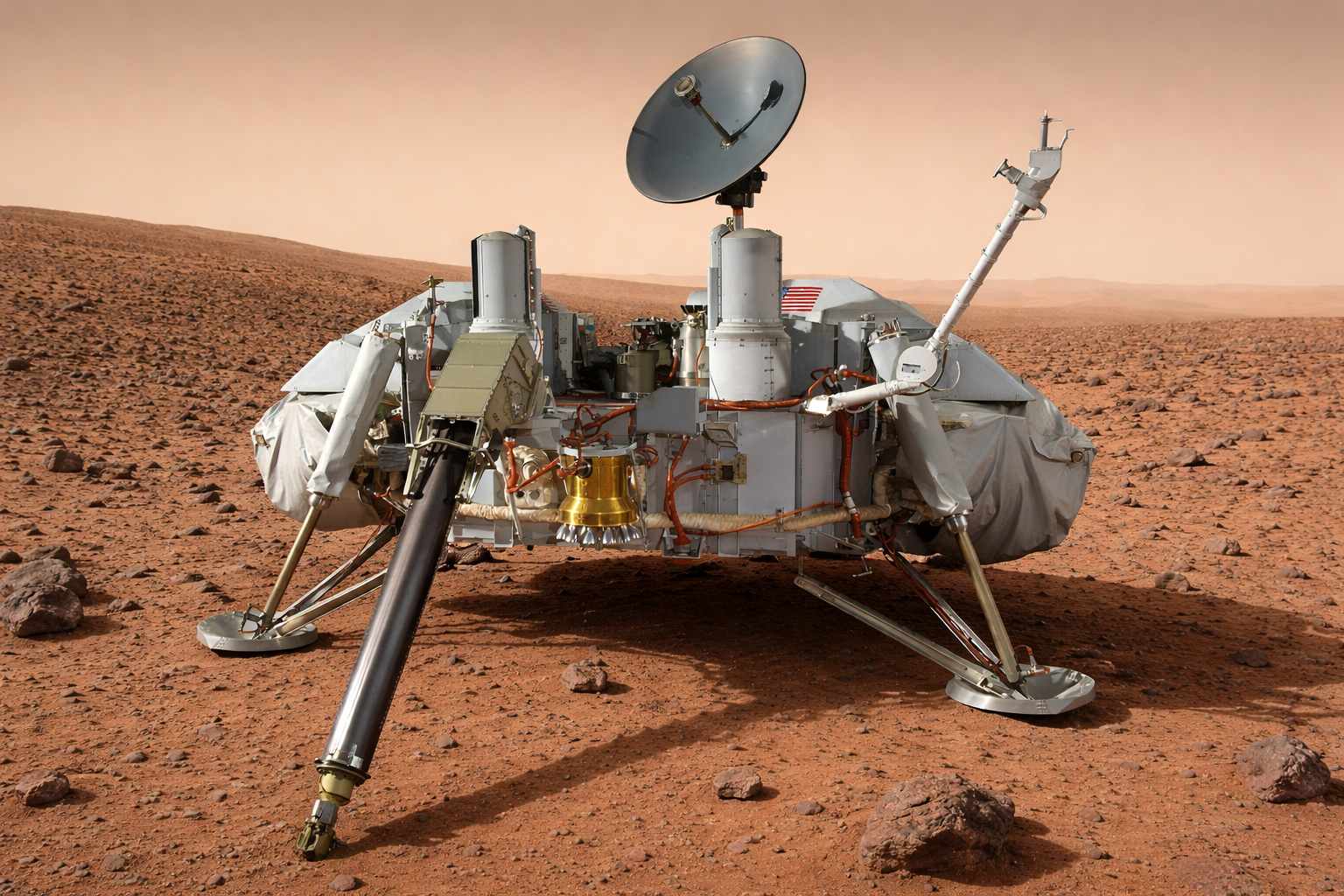
We start our series of Primordial Scoops covering the Viking results with what might be the most important of the Viking life detection experiments from an ecological point of view: A search for Martian photosynthesis or, in modern interpretation, Martian autotrophy.
The TLDR summary
• Evidence for Martian autotrophy was sought in the movement of radioactive 14C-label presented in gaseous form (14CO2) in a container into the soil in a form that was not blown out at 120 °C. About 1% of that label evidently generated 14C-labeled organic fragments when the soil was heated to 635 °C. The fragments were identified as “organic” because they absorbed on to Chromosorb-P®. 14CO2 does not absorb onto Chromosorb P.
• When tested on soils on Earth where life is sparse (e.g. Atacama Desert soils), the experiment could detect a few hundred cell equivalents. This was the basis for assuming that the test would have sufficient sensitivity for Mars.
• As a threat of a false negative, the Atacama soils contained oxidants (nitrates > perchorates) that, at 635 °C, combusted some of the 14C-labeled fixed organics to give 14CO2, which did not absorb on Chromosorb-P®. No steps were evidently taken to mitigate this threat, since the possibility that Martian soils might contain enough oxidant to combust all of the fixed organics was (evidently) not considered as a mechanism for missing evidence for Martian autotrophy.
• As a threat of a false positive, Terran alkaline soils were observed to absorb 14CO2 as carbonates without reduction. This threat was (perhaps) mitigated by a workflow that flushed 14CO2 absorbed inorganically at 120 °C.
The Details for Students of Astrobiology
This experiment was proposed by Jerry Hubbard, Norm Horowitz, George Hobby, and their team (Hubbard et al., 1970). This experiment has been variously called the “carbon assimilation experiment”, the “pyrolytic release experiment,” and the “carbon fixation experiment”. Here, we will refer to it as the HHH experiment, the initials of the three principal investigators’ last names, in no particular order. It was intended to seek Martian microbial photosynthesis. More generally, it sought out Martian autotrophy, the ability of life at the bottom of a food chain to get carbon directly from carbon dioxide (or monoxide).
The HHH experiment assumed that life contains organic matter. “Organic matter” is composed of organic molecules, molecules that contain carbon atoms that are bonded to other carbon atoms or to hydrogen atoms (molecules with C–C and/or C–H bonds).
Relatively few carbon-containing species are not organic. Carbon dioxide (CO2) and carbon monoxide (CO) are two of these. Both are available to the near-surface soil of Mars. Approximately 95% of the Martian atmosphere is CO2; approximately 0.07% is CO. Because the carbon atoms in these molecules are attached only to oxygen atoms, we call these “oxidized carbon atoms”.
Converting these oxidized carbon species into organic carbon involves the formation of C-H and C-C bonds. This process is often called “reduction”. Thus, methane (CH4) is the most reduced organic carbon atom possible, as all of the four bonds that carbon atoms are allowed to make are bonds to hydrogen atoms. Methane has no bonds to oxygen atoms, nitrogen atoms, sulfur atoms, or any of the other atoms that chemists call ‘heteroatoms’ because they are neither carbon nor hydrogen.
Carbon atoms as such cannot be said to be a limiting resource on the near-surface of Mars. Any microorganism living on Martian surface can get the carbon atoms in indefinite amounts out of the air.
Rather, the scarce resource in making organic molecules are the hydrogen atoms (and, if one wants to be technical, electrons that might go with them). The atmosphere contains only ~0.01% water vapor, H2O.* Further discussion about the availability of water is left to another blog post.
Autotrophy is at the bottom of the food chain in such a biosphere
Autotrophy (from the Greek, meaning “self-feeding”) is the process by which organic carbon is made from inorganic carbon. Assuming that the atmosphere is the only source of carbon available to near-surface Martian life, a food chain to support organic life must begin with the reduction of CO2 and/or CO to give compounds with C-H and C-C bonds.
Considering just organic molecules holding just one carbon atom, the reduction process can be written out in the order of increasing “reduction”. One-carbon reduced organics are HCOOH (formic acid), HCHO (formaldehyde), CH3OH (methanol), and CH4 (the aforementioned methane).
Of course, life cannot exist without organic species with more than one carbon atom. Therefore, a biosphere must have metabolic cycles that fix CO2 and/or CO to give organic species that contain many carbon atoms and many C-C bonds, sometimes called “higher organics”. For example, on Mars, the Curiosity rover recently identified long chain hydrocarbons possibly derived from fatty acids, which have the general structure H3C-CH2-{CH2}n-CH2-COOH, where n is an integer (Pavlov et al., 2026). You yourself have these fatty acids. It remains an open question as to whether the long-chain alkanes detected by Curiosity in mudstones on Mars are remnants of fatty acids generated by ancient Martian life.
Nevertheless, one can look for active life in an environment that provides CO2 and/or CO as the principal source of carbon by looking for carbon fixation, the conversion of CO2 and/or CO, both gases, to give higher organic molecules, which are solids in the Martian soil. You need not know the precise structure of those organic molecules to see that radiolabel is fixed.
The HHH experiment sought movement of gaseous radioactive carbon into the soil
The conversion of a gas into a solid by autotrophic microbse is key to the HHH experiment design. The structures of the organic molecules in Martian life are not known. You do know, however, that to be part of a microbe living in a soil, those higher organic species cannot be gases, at least not at the temperature where the organism lives. Thus, carbon fixation can be simply seen as the movement of carbon from the atmosphere, in gaseous compounds, into the soil, as non-gaseous compounds.
To follow the movement of carbon from the gas to a solid, the HHH experiment exploited the fact that carbon has a radioactive isotope, carbon-14. From a chemical perspective, 14C behaves (almost exactly) in chemical reactions the same as the majority carbon isotope, 12C, which is not radioactive. Every 5730 years, however, half of the radioactive 14C atoms decay, spitting out a high energy electron (also called a beta particle) that can be detected, or “counted”.
The HHH experiment planned to send to Mars a mixture of radioactively labeled 14CO2 and 14CO, in approximately the same ratio as these gases are found in the atmosphere of Mars. It planned to expose the soil to these gases, for five days, under light. An observation of 14C ending up in the soil was to be taken as a sign of active Martian photosynthesis or, more generally, Martian autotrophy.
Now for some numbers. If I have a “mole” of carbon-14 (referring not to the burrowing animal, but to a collection of ~6 x 10²³ atoms, about 14 grams of the stuff), in one minute, ~1.4 x 10¹⁴ of these atoms will decay, each spitting out a beta particle that can be detected by a radiation detector. That is, 14 grams of 14CO2 spits out about 140 trillion beta particles per minute. Or, if you prefer, 1.4 x 10¹⁴ beta particles per minute.
This scales. That is, if you have only 14 milligrams of 14C, you see only 140 billion beta particles per minute. If you have only 14 micrograms of 14C, you see only 140 million beta particles per minute. Or, if you prefer, 1.4 x 10⁸ beta particles per minute.
Since 140 beta particles per minute is easily countable above background, such experiments can detect very little 14C. In science-speak, 140 electron beta particle “counts” would come from 14 picograms (14 x 10-12 grams), or 1 picomole (10-12 mole), or about 6 x 10¹¹ atoms of 14C. Call it 1012 atoms of 14C. The 14CO2 was diluted a bit by Martian atmospheric 12CO2, but we will leave this for a later discussion,
Thus, to return a life-positive result, the HHH experiment was sensitive enough to easily see the conversion of about 1012 atoms of 14C presented as gaseous 14CO2/14CO to non-gaseous 14C. Subject to caveats discussed below, this would represent carbon fixed into organic molecules in the Martian soil by life living there.
The HHH experiment had two extremely strong attributes. First, carbon fixation must occur in any environment where CO2/CO is the sole source of organic carbon. There is no way around it, unless we are prepared to propose life that contains no carbon atoms at all, or an unknown source of organic carbon supports a Martian biosphere without autotrophy.
Further, the HHH experiment did nothing unnatural to the Martian soil. In particular, the experiment did nothing that would obviously kill Martian life living there. Martian soil is naturally and continuously exposed to these gases. The HHH experiment did not expose the soil to anything that the soil did not already find familiar. In particular, it did not add liquid water in abundance to the soil. Liquid water in any amounts was a rare event at the Viking sites.
Nor did the experiment make any assumptions about what the organic molecules were in Martian life, or what Martians liked to eat. Or what they might find poisonous. These advantages were all noted by the HHH team itself in its papers in 1970 and in many papers thereafter.
The false negative problem
But this does not mean that the HHH experiment would be totally unambiguous. As they developed the experiment, the designers needed to worry about false positive and false negative results that might that might lead to an incorrect conclusion.
In general, the false negative problem involves the statement “There is life in the Martian soil, but we cannot detect it.” At one level, this is simply a sensitivity question, something having to do with what chemists call a “limit of detection”. Even though we are using radioactivity as a probe, and even though radioactive measurements are the most sensitive that we have available, the life in a Martian soil sample might be too sparse to fix 1012 carbon atoms.
We could, of course, say that if the amount of Martian life is so little, we are not interested in it. But at least we should make a fair guess to how much life we could detect in the HHH experiment.
This is easy enough to do if we are willing to use Earth bacteria as a benchmark. For example, an E. coli cell has 1010 carbon atoms If these were all 14C-labeled, a single bacterial cell would generate ~1.4 high energy electrons per minute. A photosynthetic blue-green algal cell (called cyanobacteria in the trade) has similar amounts of carbon.
This is barely above background, but adequate if you count electrons for 100 minutes. So this “back of the envelope” calculation says that if the Martian soil contained one E. coli cell that divided over the course of its exposure to 14CO2 to give a second cell whose carbon came entirely from that gas, one might be able to detect it if one looked for high energy electrons for 100 minutes. Ten cells would be better. One hundred cells for sure.**
This can be compared to the number of cells in soils on Earth that are resource-starved. For example, soils from the high Atacama Desert in Chile contain 100-10000 cells per gram of soil in its driest regions. A milliliter of glacial ice from the Antarctic plateau glacier contains 10-1000 cells (Christner et al., 2001). Farmland soil, by comparison, contains billions of cells per gram.
Of course, these calculations assume 100% efficient counting of the fixed 14C. For example, inefficient movement of the 14C-labeled higher organics in Martian microbes into a spot where its radioactivity could be detected would be a source of false negatives.
Seeing the fixed 14C directly in soil samples is difficult
The next step of the HHH architecture required that one detect the fixed non-volatile radioactive 14C label carbon in organic molecules in the soil. This is conceivable, and we will propose experiments to do so that exploit the Spacek IMPRESS ride share penetrator architecture in a later Scoop in this set.
However, the beta particles coming from 14C are not strong enough to penetrate through much soil. The soil absorbs them. Thus, even if one put the soil on top of a Geiger counter, the efficiency of counting of the 14C decay particles would be low, even if we neglect the fact that the Geiger counter window would absorb fewer of them.
Therefore, the original HHH paper developed a workflow that sought to get the fixed non-gas 14C back out of the soil … as a gas. Here, the idea was to heat the soil to a temperature high enough so that the nonvolatile fixed 14C-labeled “higher” organics became volatile 14C-labeled organic fragments of the originally fixed higher organics. Think by analogs of the small organics that you can smell from burnt popcorn.
And what temperature was hot enough to do this “pyrolysis”? Based on experience with Terran organics, the HHH team decided to do pyrolysis at temperatures greater than 600 °C. The Viking experiment on the Martian surface eventually used 635 °C as the pyrolysis temperature (Fig. 1).
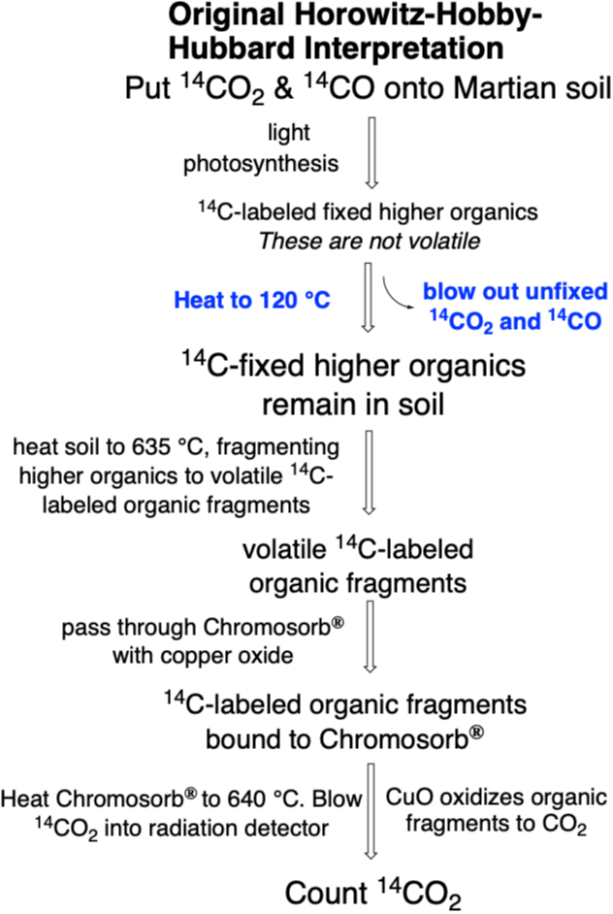
Figure 1. It is difficult to detect 14C radioactivity in soil; the soil absorbs many of the beta particles emerging from the decaying atoms. Thus, the HHH experiment used this workflow to fragment by heat (635 °C, “pyrolysis”) the 14C-organics made by putative autotrophic microbes to give smaller 14C-labeled radioactive organic fragments (analogous like the organic fragments that give burnt popcorn its smell). These would come off the soil and be absorbed on Chromosorb P®.
This “pyrolysis”, when applied to large biological non-volatile organics, converts them into smaller volatile organics. Molecules that still contain reduced carbon, but small enough to evaporate at 635 °C. Think of the organics that come off of burnt popcorn that give a burnt popcorn its distinctive smell. The HHH experiment would detect radioactivity in these, aftr it fed radioactivity to the growing corn.
As we will see in a moment, pyrolysis has complications. If oxygen atoms are around, some of the 14C-labeled higher organics will end up in 14CO2, not as smaller organic fragments.
This will certainly happen when the oxygen atoms that are around are in the form of atmospheric O2. In other words, heating organics in Earth’s atmosphere results in combustion. Try heating popcorn to 635 °C; you will set the popcorn on fire. And the 14CO2 coming from the burning popcorn (or Martian organics) must not be confused with the 14CO2 that we used to feed the corn (or the Martians) in the first place.
The HHH team was aware of this, and developed its workflow accordingly. In Earth-based development of the experiment, atmospheric O2 was excluded. Then, the vapors coming off of the heated Martian soil were passed through something called “80 to 100 mesh firebrick, Sil-o-Cel” that had been coated with copper oxide (CuO).
So what is Sil-o-Cel? It is a form of diatomaceous earth. This is silica material that is the fossilized skeletons leftover from small organisms called diatoms. And its value in the workflow? It absorbs small organic fragments. It does not absorb CO2.
I have tried to buy some Sil-o-Cel in an attempt to reproduce the HHH experiment as it was originally run on Earth in 1970. It seems to no longer be available. However, to replicate the Viking experiments, we can use Chromosorb P®, which was as actually used on the Viking experiments on Mars (Klein, 1974). It is still available.
So you can see how the workflow was developed in concept. The biosignature is the conversion of volatile gaseous radioactivity in the form of 14CO2 into non-volatile 14C-labeled higher organics in the Martian soil. If seen, this will be interpreted to be a sign of Martian photosynthesis, or, more generally, Martian autotrophy.
Again conceptually, the designers could not figure out how to count the radioactivity in the soil directly because the soil would absorb the beta particles before a detector would have a chance to see them. So the workflow heated the soil to 635 °C to fragment (pyrolyze) the higher non-volatile organics into small organic fragments that would, at this high temperature, vaporize.
Then, the volatile small 14C-labeled organic fragments would be absorbed onto Chromosorb P®, with a small amount of 14C-labeled higher organics that ended up as volatile 14CO2 (from the oxygen was already in the soil) passing through the Chromosorb P® and directly into the detector. This 14CO2 would be counted as “Peak 1”.
So far so good. But you may have noticed that this workflow so far only trades one problem for another. One cannot count the “higher” non-volatile organics directly in the soil, because the soil would get in the way. But one also cannot count radioactivity the volatile organic fragments in the Chromosorb P®, because the Chromosorb P® material would get in the way.
Copper oxide (CuO) was put into the Chromosorb P® to solve this problem. In the HHH workflow, the 14C-labeled organic fragments were trapped at low temperature in the Chromosorb P®. Then, the trap would be heated up to 640 °C. At these high temperatures, the copper oxide would oxidize any trapped 14C-labeled organic fragments to give 14CO2. In this reaction, CuO provides the oxygen atoms.
This newly generated 14CO2 would not continue to absorb to the Chromosorb P®. Instead, it would emerge as a free gas that, at last, could make it to a detector where its beta particles could be counted. As “Peak 2”.
This workflow was put together in an Earth-based experiment, which the HHH team published in 1970 in preparation to sell it for the Viking mission (Hubbard et al., 1970). During the Earth-based instrument development, the 14C electrons were counted with 57% efficiency. The counting period lasted for 100 minutes, to allow a 2-sigma error of <7%. The background was about 14 counts per minute.
Using this device on Earth, HHH team was able to detect carbon fixation in a wide variety of soils. These included soils from the Atacama Desert, where the biosphere is as sparse as it gets anywhere on Earth. A few hundred cells were well within its limits of detection
Warning signs of potential false negatives were seen
As the HHH team tested the soils from the Atacama Desert, they observed nitrate (NO3–) in their samples. As any schoolchild pyromaniac knows, nitrate burns organics to give CO2. This is how classical gunpowder works.
The HHH team noticed this process as they pyrolyzed soils containing nitrate. They remarked that “the pyrolysis was converted to a partial combustion” by the nitrate. In simpler words, if the soil contained nitrate, even with atmospheric O2 excluded, some of the 14C fixed into organics was converted not to organic fragments that were trapped on to Chromosorb P® and later counted as Peak 2 but to 14 CO2, which passed through the trap and counted as Peak 1. In a fateful passage, the HHH team dismissed this by writing: “Nonetheless, even in this poor example [from the Atacama Desert], a significant yield of 14C was detected in the trapped organic fraction.”
“Poor example?” What they meant was that the Atacama soil contained not enough nitrate oxidant to burn all of the organics that were present. The left over organics continued to generate burnt-popcorn-smell fragments that were absorbed on Chromosorb P®. The team did not remark that if the Martian soil contained more nitrate than the Atacama soils, in particular, nitrate in excess of the higher organics, then all of the 14C-label fixed by Martian life might be lost through the Chromosorb P® trap as 14CO2. A false negative.
In any case, they evidently took no steps to mitigate this problem.
Replace “nitrate in Atacama soils” by “perchlorate in Martian soils”, and you are half way towards understanding the results from the HHH experiments on the Viking 1976 landers. As we shall see in a later Scoop, Klaus Biemann, who ran the Viking gas chromatograph-mass spectrometer (GC-MS), considered the possibility that nitrate was present in the Martian soils when he analyzed his Viking data. However, he dismissed this possibility in a way that was not wholly logical.
But we are getting ahead of ourselves. The HHH experiment was prepared to detect 14CO2 coming from fixed organics by a workflow that involved pyrolysis of the organics to give organic vapors, trapping the vapors in a material that did not trap carbon dioxide, oxidizing them to 14CO2, and counting the 14CO2 that emerged from the Chromosorb P (Peak 2). In a pre-flight paper, pyrolytically generated 14CO2 was recognized as being a biosignature as well (Horowitz et al., 1972). Thus, it was counted as Peak 1, both on Earth and on Mars.
Warning signs of potential false positives also were seen
The HHH team also considered false positives. Prime among these was the possibility that the 14CO2 would react with alkaline soils to make bicarbonate and carbonate salts, not be flushed out at 120 °C, and be released only when the soil was heated to 635°C. The workflow lacked a strategy to distinguish 14CO2 that comes fr0m:
(i) non-biologically absorbed as carbonates, and released only at higher temperatures versus
(ii) 14CO2 from biologically generated organic materials pyrolyzed at 635°C, where oxygen came from the soil.
On Earth as the HHH experiment was being developed, the team saw substantial amounts of 14CO2 absorbed on to soils that had been sterilized to kill biology. Sterilized Atacama soil (which the HHH team numbered Sample 264) absorbed large amounts of CO2 without biology. This radioactivity, interpreted as absorbed carbonates, was released by pyrolysis, but not trapped on Chromosorb P®.
The HHH team did not focus on this problem, exactly. Rather, the HHH team was most concerned that perhaps a small amount of this 14CO2 would be caught on the Chromosorb P®, to be later released in the last step of the workflow, and confused with the 14CO2 arising from 14C-labeled organic fragments that had been oxidized by copper oxide.
The HHH team considered another possible false positive. Very few non-biological processes convert gaseous CO2 into higher organics. The HHH team considered one, the reaction of phenol (hydroxybenzene) with CO2 to give salicylic acid. Heating salicyclic acid regenerated 14CO2, which was not caught by the Chromosorb P®. In this interpretation, non-trapped pyrolysis radioactivity was not to be counted among the biological activities.
A final possibility for a false positive was reported by the HHH team in 1971 (Hubbard et al., 1971). The Martian surface, like Earth’s, is bathed in sunlight. Because Mars is ~1.52 AU from the Sun on average, it receives ~43% of Earth’s solar input. However, the oxygen atmosphere on Earth creates ozone in the upper layers of the atmosphere. This filters out the harshest ultraviolet light. Unfortunately, on Mars, that harsh ultraviolet light comes all the way down to the surface.
In a series of experiments run on Earth, the HHH team discovered that 14CO, when it interacts with this high energy ultraviolet light, gets fixed to organics without any biology at all. Fearing that this would be mistaken on Mars as photosynthetic carbon fixation, the mission did not use Solar light in these experiments. Rather, Viking brought along its own light source that did not present hard ultraviolet light to the soil. This was hoped to be able to avoid this particular false positive.
The HHH experiment flew without mitigating false positive and falses negative possibilities
At the end of its Earth-based development, the HHH instrument was ready to fly. Its workflow was impeccably natural. Other than the scooping itself, and perhaps the illumination by an artificial lamp, the experiment did nothing to kill indigenous Martians, not by changing their atmosphere, not by changing the carbon compounds that they had access to, not by poisoning them, and not by putting water on them.
However, the experiment flew with two poorly managed problems.
As the false negative problem, if the Martian soil contained nitrate, some (or all) of the 14C-labeled organics fixed into higher organics by autotrophic Martians would be burned to give 14CO2. This would pass through the Chromosorb P, and not be counted as part of the total fixed carbon budget. If nitrate were present in excess over the fixed 14C-biological higher organics, all of the fixed 14C would be missed.
The HHH team saw this problem, but took no steps to mitigate it. In the specific soils that they had tested on Earth, the nitrate was not present in sufficient amounts to convert all of the fixed 14C into 14CO2. Thus, the team saw only partial combustion, and concluded that this left behind enough fixed organics to still give an affirmative life detection result. They evidently did not consider the possibility that the Mars soils would contain more nitrate, and thus complete the combustion.
As it turned out, the Martian Viking soils contained perchlorate, in large amounts. Perchlorate in large amounts would also combust higher organics at 635 °C. This process will be detailed in the next scoop.
As the false positive problem of the HHH experiment, if the Martian soils were alkaline, then they would non-reductively absorb 14CO2 as carbonate or bicarbonate minerals. This 14CO2 might be released at 635 °C, become “Peak 1”, and be misinterpreted as fixed carbon that had been converted to 14CO2 using oxygen atoms from the soil. Here, it appears as if the HHH team thought that by heating the soil to 120°C prior to pyrolysis prior to heating to 635° C and flushing out what came off the soil, they would be able to release the non-reductively absorbed 14CO2. However, I have not been able to find a specific spot where the team says this explicitly. It did say explicitly that this non-reductively absorb 14CO2 would pass through the Chromosorb P.
As we shall see, the Viking version of the HHH experiment at two sites on Mars saw some 14CO2 fixed that led to burnt popcorn fragments absorbed on Chromosorb P. This amount of 14CO2 corresponded to ~1000 E. coli cells. However, it saw 100 times more 14CO2 emerging directly from the soil when heated at 635 °C, even though the soil had been flushed at 120°C. This could either mean that the soil had fixed enough 14CO2 for 100,000 cells, with perchlorate destroying the burnt popcorn smell. It could mean that 14CO2 had been absorbed as a carbonate/bicarbonate stable at 120 °C but not at 635°C. Or it could mean that the 14CO2 was absorbed as salicylic acid.
This is the lead to the next blog post. As we shall see, by the time that the HHH team got to Mars, they had largely forgotten the possibilities for both the false positive and the false negative result that they had recognized in their Earth-based experiments. And “perchlorate” evidently never occurred to them.
The article was posted after minor revisions by Jan Spacek on 2/18/2026.
Spacek’s notes:
*Martian atmosphere holds 10-20 ppmv of H2 while Earth atmosphere holds only ~0.5 ppmv of H2, making the Martian hydrogen gas a viable alternative source of hydrogen atoms for carbon fixation via trace gas metabolism, in process similar to one known from Earth’s polar soils – even after we account for the pressure differences between the atmospheres. In absolute values Mars atmosphere holds 3-6x less H2 than Earth’s atmosphere. If perchlorates are allowed to be used as electron acceptors, water used for metabolism can be generated from H2 oxidation.
**Hubbard et al (1970) states that the method “easily detects” 100-1000 algae in 0.25 cc of soil after 3-24 hours. However, simple observation of the bulk metabolic rates in a sample cannot distinguish whether Martians are sparse and active metabolizers, or abundant and lazy metabolizers. The results would be the same for sample that contain just one super-active cell that duplicated fully or 1000 “lazy” cells each gaining only 0.1% of new carbon mass using the labeled carbon. Using an analogy from slowly metabolizing life in energy sparse environments on Earth, one might expect more chilled life style.
References
Christner, B. C., Mosley-Thompson, E., Thompson, L. G., & Reeve, J. N. (2001). Isolation of bacteria and 16S rDNAs from Lake Vostok accretion ice. Environmental Microbiology, 3(9), 570–577. https://doi.org/10.1046/j.1462-2920.2001.00226.x
Hubbard, J. S., Hobby, G. L., Horowitz, N. H., Geiger, P. J., & Morelli, F. A. (1970). Measurement of 14CO2 assimilation in soils: an experiment for the biological exploration of Mars. Applied Microbiology, 19(1), 32-38.
Hubbard, J. S., Hardy, J. P., & Horowitz, N. H. (1971). Photocatalytic production of organic compounds from CO and H2O in a simulated martian atmosphere. Proceedings of the National Academy of Sciences, 68(3), 574-578.
Klein, H. P. (1974). Automated life-detection experiments for the Viking mission to Mars. Origins of life, 5(3), 431-441.
Pavlov, A. A., Freissinet, C., Glavin, D. P., House, C. H., Stern, J. C., McAdam, A. C., … & Gomez, F. (2026). Does the Measured Abundance Suggest a Biological Origin for the Ancient Alkanes Preserved in a Martian Mudstone?. Astrobiology, doi:10.1177/15311074261417879.
Spacek, J., Benner, S.A. (2022) Agnostic Life Finder (ALF) for large-scale screening of Martian life during in situ refueling. Astrobiology 22, 1255-1263. doi.org/10.1089/ast.2021.0070