Autotrophy on Mars (1): Tests to Detect Martian Photosynthesis

Autotrophy on Mars (1): Tests to Detect Martian Photosynthesis

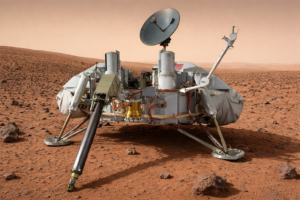
Here I examine Viking’s carbon assimilation (a.k.a. “pyrolytic release”) experiments aimed to detect Martian autotrophy by following labeled carbon from atmospheric CO/CO₂ into soil organics, followed by the release of labeled volatile gases by pyrolysis. These experiments were prone to both false negatives (oxidants burning organics) and false positives (alkaline soils binding CO₂). And yet when taken in context of the current understanding, these results might be the most important in the series of the Viking biological experiments and are worth studying in detail.
The Viking Experiments on Mars: An Overview

The Viking Experiments on Mars: An Overview

Half a century ago, Viking delivered evidence suggesting metabolically active life on Mars, but its legacy was derailed by a mistaken GC–MS interpretation that shaped Mars exploration for decades. This is the firsts article in a series that reexamines Viking’s experiments and results from primary data, shows how they were (mis)interpreted, and that suggests life-finding strategies.
Martian water management with biofilm slimes, a speculation.

Martian water management with biofilm slimes, a speculation.

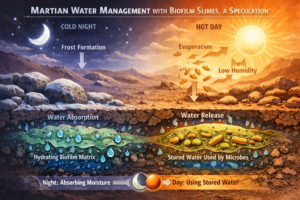
Martian life is exposed to many stressors at once, but temperature and water availability dominate because they jointly decide whether chemistry can run in a liquid solvent. Warm periods exist, yet they coincide with brutal daytime drying. I argue that a plausible loophole is not only “finding” deliquescent niches, but extending them: microbes could store night moisture inside extracellular matrix (biofilm) and use that stored water during the warm daytime window, enabling faster metabolism.
IMPRESS to Deliver Art and Science to Mars

IMPRESS to Deliver Art and Science to Mars

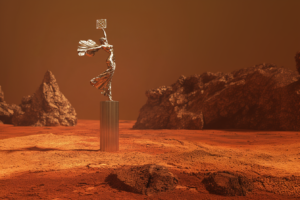
The image depicts a concept art: a five meters tall titanium penetrator imbedded in the Martian soil. The scientific payload and cameras broadcasting statue's selfies reside in the half-buried pedestal. Long after the science mission ends, this statue will serve as a landscape feature and a message to the future generations.
Science, Hype, and Prebiotic Chemistry

Science, Hype, and Prebiotic Chemistry

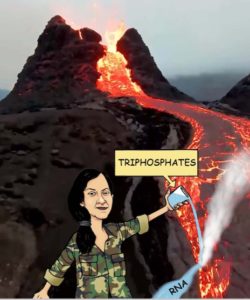
Commenting on our report that basalt glass catalyzes formation of polyribonucleic acid, Jack Szostak found it "very frustrating that the authors have made an interesting initial findings but then decided to go with the hype rather than the science". This offers an opportunity to discuss classical chemical structure proof, and the timing of scientific publications.